— A better lens probably helps. But first, what are you actually unhappy with in the lens you already have?
When I Felt a Lens Was “Not Enough”
At the end of the previous article, I asked whether, once the sensor itself becomes finer, the lens has to be “enough” for it. This article is about that.
Let me first write down the story a reader is likely to expect. The camera's megapixel count goes up. Lens flaws that were invisible before become visible. So you need a better lens. — That, I think, is probably the story you are expecting.
To be honest, my memory did not unfold that way.
At the beginning of digital, in the D1 and D1X days, there really was a strong worry that lenses were not suited to digital. But that was mainly a matter of compatibility between the lens and the sensor: how light entered, stripes against the light, “digital-compatible” lenses. I wrote about that in the previous article, so I will not repeat it here. As far as I remember, at least, the worry was not of the form “the lens's resolution is not enough for the megapixels.” And as designs made for digital became the norm, I gradually stopped thinking about the problem at all.
After that, the bodies got finer. The D2X, the D3, the K-1, and the S1R I used once for a job. Through all of that, for ordinary daytime shooting, I have no strong memory of feeling that “the higher megapixel count made the lens's flaws visible.”
It Just Got Finer
The S1R is a camera of about 47 megapixels. When I used it for the job, I do not remember being warned about lenses, and I never felt while shooting that “this lens isn't up to it.” What I remember is a much plainer reaction: “Oh — it really does render the fine detail.” That was all.
The K-1 was the same. On that camera of about 36 megapixels, I do not remember hearing from Pentax anything like “this lens will struggle on the K-1.” Nor has a lens's lack of resolution ever become an actual problem for me at ordinary print sizes. It might show up if I enlarged much further; I have not checked.
This is one camera, and one person's memory. I have no intention of turning it into “lens limits do not exist.” All I can say is this: the day the megapixels went up and a lens that had been usable suddenly became unusable — that is an event I have not experienced.
Let Me Give the Answer Here
From my side, it comes to this. If someone asks me whether a high-megapixel camera needs a high-resolution lens, this is what I answer today. A better lens probably helps. But first, what are you actually unhappy with in the lens you already have?
This does not mean that high-performance lenses are unnecessary. It only changes where the question starts. Not “how many megapixels is this lens good for,” but “what, in my own photographs, is actually showing up as a problem?” If nothing is, then the megapixel number alone gives you no reason to change lenses. If something is, then what that something is, and where it shows, is what decides the next lens.
From the sources' side, let me also give the answer up front. The lens and the sensor are not two numbers where the smaller one wins. The lens decides how much contrast survives into the image at each level of detail. The sensor decides how finely it samples the image the lens has made. The photograph is the result of both. In this article I will treat that as a multiplication: the lens and the sensor combine — multiply, in effect. But it is not megapixels times megapixels. It is the contrast that survives at each level of detail, multiplied stage by stage.
So the calculation “this lens is 30 megapixels, the sensor is 50 megapixels, therefore the photograph is 30 megapixels” does not hold as physics. And I am not going to replace it with a different megapixel formula in this article either.
“This Lens Is Good for So Many Megapixels”
Even so, the phrase “this lens is good for so many megapixels” really does exist. As I understand it, it is a mixture of three different things with three different origins.
One is manufacturer recommendation. When Nikon released the 36-megapixel D800 (in 2012), for example, its technical guide listed a dozen or so lenses “you can use for enhanced sharpness.” What it says is “can use,” not “need,” with the caveat that results vary from lens to lens and some advice about apertures. Nowhere does it say that other lenses cannot be used.
Another is a testing site's score. A well-known one expresses a lens's sharpness as a single megapixel-equivalent number. It is a number obtained by measuring how contrast is transferred under a defined method, weighting by the eye's sensitivity and by position in the frame, taking the best aperture, and averaging over focal lengths. For comparing lenses on the same camera, it is useful. But the testing site itself explains that the number is measured for a lens–camera combination. Put the same lens on a different camera and the number changes. It is not a property of “so many megapixels” stored inside the lens.
The third is internet shorthand. Phrases like “lenses for high-megapixel sensors” or “this lens resolves 50 megapixels” are, I think, the two things above coming loose and circulating as if they were a property of the lens alone. In the standard's terms, a pixel count is a count of addresses; it is not resolution itself.
None of this means the numbers are meaningless. It means that until you say under what conditions, and in combination with what, a number was measured, “enough” or “not enough” cannot be judged. That is all.
The Image Is Decided by Lens × Sensor
So how do the lens and the sensor act together?
A lens passes coarse patterns to the image at high contrast, and finer patterns at lower and lower contrast. A sensor samples that image at a fixed fineness. A coarse sensor cannot resolve the fine patterns the lens delivered, and drops them. A fine sensor picks them up. What remains in the photograph is the contrast the lens left, combined with the fineness the sensor can pick up, at each level of detail.
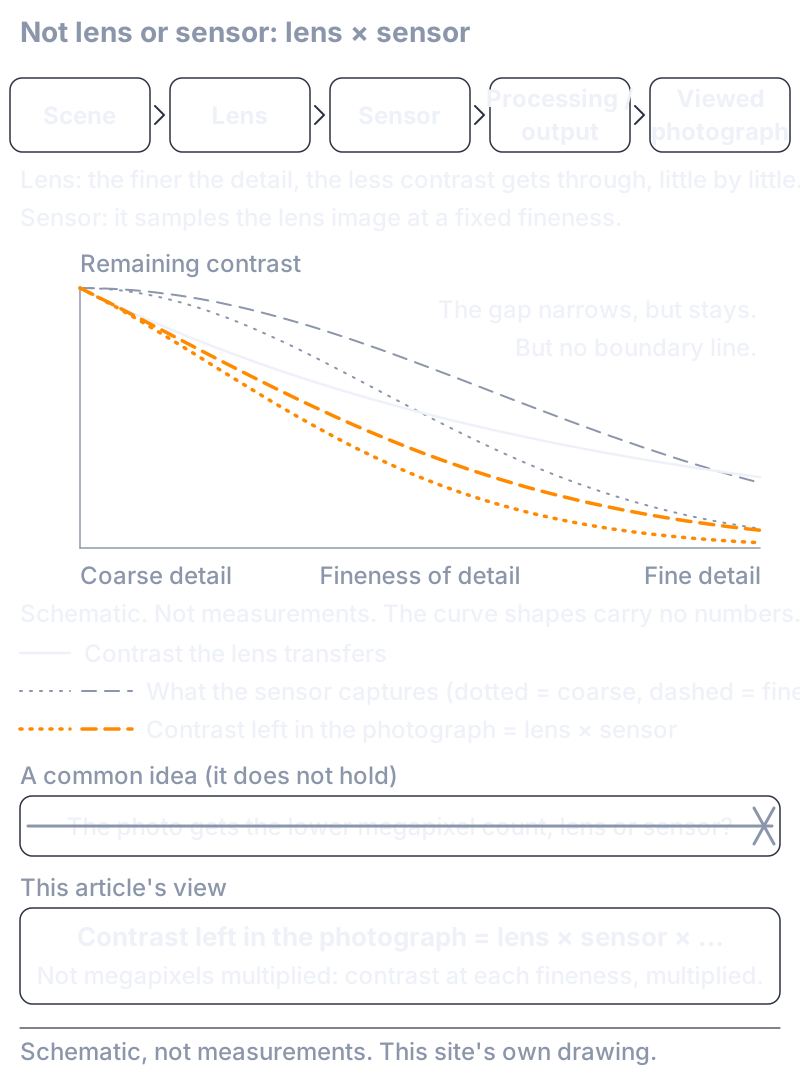
Figure 1: Not lens or sensor — lens × sensor. Top: the chain from scene through lens, sensor, processing and output to the viewed photograph. Middle: a schematic of how much contrast remains at each level of detail — the lens curve, a coarse and a fine sensor, and their combinations; the fine sensor's combination is never below the coarse one at any level, but the gap narrows toward fine detail. There is no single boundary line between lens and sensor. Bottom: the idea that the photo simply gets the lower megapixel count of lens and sensor is struck out, and replaced by “contrast left in the photograph = lens × sensor × …”. The curves are not measurements and carry no numbers. Not a ranking; it shows how the image is decided. This site's own drawing.
What matters here is that a lens's contrast does not suddenly drop to zero at some level of detail. It falls as the detail gets finer. Even as it falls, something is still there. And if something is still there, a sensor that samples more finely records that much more of a difference. Even a lens that people say “won't resolve that many megapixels” still leaves a little contrast at those levels, and a finer sensor picks up that little.
From the sources' side, the clearest treatment of this I know is a technical paper Zeiss published in 2009. It shows by calculation that even when the lens's limit is lower than the sensor's, doubling the pixel count still improves how the image is transferred. And in real shots, even at f/22, where both cameras are limited by diffraction to about the same degree, the finer sensor still comes out ahead. The paper also says, in effect, that the idea that “the weakest link sets the limit for everything” holds only when the optics are very poor.
Two things need adding, though. One is that the returns diminish. The finer the detail, the less contrast the lens leaves, and the smaller the difference there is to pick up. This is not a story where more and more megapixels yield ever more detail without end. The other is that whether this difference means anything in a photograph is decided by the output and by how it is viewed. That comes in a later section.
What Showed the Difference Was Not Megapixels. It Was Stars.
In ordinary daytime shooting, I hardly feel any practical difference between decent lenses. That may be the flip side of the fact that the camera I use day to day is in the 24-megapixel class. I do have lenses I like: the SIGMA 85mm F1.4, the LUMIX 50mm F1.4. But I would not say I could not have made the photographs without them, and if the results were lined up and viewed normally, I think I might not be able to tell them apart with any certainty myself.
The moment lens choice suddenly became weighty was not when the megapixels went up. It was when I started photographing stars.
The SIGMA 14-24mm F2.8 is a very good lens for stars, and I knew its reputation for that use. Later I bought the 14mm F1.4, also from SIGMA. The reason I bought it was simple: “I can drop the ISO two stops with that.” That was all. When I used it, it was in a different league. What differed most was the way coma showed up.
From the sources' side, let me add just a little. A starry sky is a subject of small point sources scattered across the whole frame, and the maker itself describes it as a very demanding subject for a wide-angle lens. A point source shows directly how the lens renders a single point — the shape of the point image. In an ordinary scene, countless point images overlap and average out, so that shape is not seen. A defect like coma, where the point image trails a tail, does lower the contrast curve used in numerical lens evaluation, but the shape and direction of the tail do not show up in that curve. So two lenses that looked “the same” in a daytime landscape can look like different things on stars.
I want to say only one thing here. This large difference did not become visible because I changed the megapixel count. It became visible because the subject changed. What showed the difference between lenses most strongly was not the sensor. It was the subject. Which of the two lenses is the better one is not something this article will discuss.
What I Saw at 100%, and What Remains in the Photograph
I had long felt that images stopped down to f/22 looked a little soft. But that was something I saw on a monitor at 100%. I did not confirm it in a print.
Diffraction itself is a physical phenomenon; it is real. But as I wrote in Is f/8 Really the “Best” Aperture? and Is a Lens Really at Its Best 2–3 Stops Down?, there is no f-number at which diffraction “begins.” A high-megapixel body does not add diffraction. It only records the same diffraction-affected image more finely. At 100%, the finer the pixels, the more the same image is magnified on screen, so the softness becomes easier to find. That does not mean a universal upper limit on aperture has appeared, nor that the finished photograph has failed.
The talk of diffraction being more conspicuous with higher megapixel counts is in my mind too, and I do think it may be better not to stop down too far. But honestly, in choosing the actual aperture, in the end it comes down to the tug-of-war with depth of field.
I also have an experience that runs the other way. Showing images shot with a kit lens on a tablet, I have more than once had a maker's representative react with something to the effect of “Wait — this lens shoots this well?” Which maker, and which lens, I will not write here. This is not a story that a kit lens is the same as a premium lens. It is a story that the photograph people finally see can be better than the lens's rank would lead you to imagine.
“A difference is visible” and “the difference matters in the finished photograph” are different questions. Viewing at 100% is a condition for inspection, not the condition under which a photograph is seen. I wrote about that in What Is Your Circle of Confusion?. Never having experienced a lack of resolution in ordinary prints, having seen the f/22 softness only at 100%, having people surprised by kit-lens images — these all connect to the same one thing. That a difference can be measured and that a difference matters are not the same.
Three Ways of Putting It, and None of Them Is Enough
Line all this up and it becomes clear that three common ways of putting it are each not enough.
“A high-megapixel camera needs a high-resolution lens.” Until you decide what you are looking at, in what output, and how closely, whether it is needed cannot be judged. “Any modern lens is the same.” Stars are the counterexample. The advantages of a good lens are real. “This lens is good for so many megapixels.” That is a number measured for a lens–camera combination, not a property of the lens.
I myself do not carry old film-era lenses out just to test whether they are enough for today's cameras. I have modern lenses of about the same focal lengths on hand, so I cannot say from my own experience whether old lenses are enough for today's cameras or not. The 85mm f/1.4D in the previous article is one counterexample to the phrase “old lenses are no good on digital,” not a statement about old lenses in general.
“Enough” Is Not Decided by the Lens Alone
Here, let me set these events in the way this series looks at things.
Whether a lens is enough is not decided by the lens alone. It is decided by what you look at, and where. — That is this series' way of putting it.
In the previous article I wrote that with digital, what sat behind the lens changed. This article is its continuation. When the sensor behind the lens becomes finer, no single boundary line gets drawn between it and the lens. Only the other factor in the multiplication changes. And whether the result of that multiplication means anything is decided further back still — by the output, and by the conditions of viewing.
As for how I actually work, it is this. I choose the aperture by balancing it against depth of field. Sharpening, I think I apply almost none. The right amount of sharpening cannot be separated from the final output, so when I send work to print or to a lab, it is sometimes better to have it applied on the output side. This does not mean sharpening makes up for what the lens lacks.
My Answer to “Does It Need One?”
Does a high-megapixel camera need a high-resolution lens?
Using a good lens has meaning. With more megapixels, differences that were hard to see before can sometimes become visible. But from that, no single boundary line of the form “this lens is good for so many megapixels” emerges. A boundary line can be drawn only once you have decided what you are looking at, in what output, and how closely.
How much the people around me argued at the time that “lenses can't keep up with high megapixel counts,” I do not really remember. Perhaps I simply was not interested. Whether my own thinking has changed between then and now, I cannot say for certain either.
All I can say is what I answer today. A better lens probably helps. But first, what are you actually unhappy with in the lens you already have?
Once the lens alone stops being the answer, the next question becomes: in today's high-resolution systems, what else besides the lens decides the image? The tripod, the ISO, the aperture, the shutter? That is for the next article.
For Those Who Want to Know a Little More
The conclusions this article needs are complete above. What follows is supplementary, for those who want a closer look at the grounds for what the main text kept short, and at what is not known. There are no new claims.
How a Lens Transfers, and How a Sensor Samples
A lens's performance is expressed as a curve (MTF) of how much of the original contrast survives into the image at each level of detail (spatial frequency). It falls as the detail gets finer, and at some point becomes effectively zero. A sensor samples the image at its pixel pitch, and patterns finer than twice that pitch cannot be recorded correctly (the Nyquist frequency). That is a boundary of recording, not a guarantee that resolution extends that far. The international standard for measuring image resolution (ISO 12233) likewise distinguishes pixel count (the number of addressable photoelements) from resolution, and treats resolution as a response at each level of detail. Color-filter arrays, the presence or absence of a low-pass filter, and RAW processing differ from model to model, so the same pixel count does not give the same result.
The Product — Why “the Weakest Link Wins” Is Too Crude
The way contrast survives through the whole system can be approximated, locally, as the product of each stage — the lens, the glass stack in front of the sensor, the pixel aperture, motion and focus, processing. The Zeiss paper gives the example that if, at some level of detail, the lens is at 65% and the sensor at 30%, the system is at 20%. Because it is a product, even when the lens's limit is below the sensor's, raising the sensor's curve raises the product. “Only the weakest link's limit decides the whole” holds, approximately, only when the optics are very poor. Processing (RAW development, sharpening) is nonlinear, and there are parts of it a simple product cannot express.
Why Finer Sampling Keeps Information
The same paper shows a calculation combining two lenses, of 80 and 160 lp/mm (a poorer and a better one), with a 24-megapixel sensor whose Nyquist frequency is 84 lp/mm and a 12-megapixel sensor at 59 lp/mm — four combinations in all. Its summary: doubling the pixel count improves the transfer even when the sensor's resolution exceeds the lens's; the poorer lens on 24 megapixels comes out almost as good as the better lens on 12; and the differences are smaller than the numbers 12 and 24 might suggest. In real shots, at f/22 the optical resolution of both cameras was limited by diffraction to about 75 lp/mm (below the 24-megapixel Nyquist frequency), and the finer camera still came out ahead. This is one paper's example, on one set of equipment. Finer pixels sample the same image up to a higher frequency; because the pixel aperture is narrower, the response at a given frequency is higher; and aliasing is reduced. A low-pass filter, on the other hand, reduces aliasing at the cost of high-frequency contrast, and sharpening changes the look of the response but does not recover information that was lost.
How a “Lens Megapixel” Score Is Made
The testing-site score mentioned in the main text (DXOMARK's P-Mpix, “perceptual megapixels”) was introduced in 2012. According to the published description, contrast response is measured by the ISO 12233 method, weighted by the sensitivity of human vision, weighted so that the corners of the frame count less than the center, the maximum over the aperture range is taken at each focal length, and the result is averaged over focal lengths, to express the sharpness of a lens–camera combination in megapixel-equivalent terms. It also states that “a difference of less than 1 P-MPix is usually not noticeable.” The full formula is not published. What the score lets you compare is the order of perceived sharpness among lenses on the same camera; it does not carry over to other cameras, and it does not cover behavior at each aperture or position in the frame, or behavior on point sources.
Point Sources and Ordinary Scenes
The Zeiss paper (2008) writes that the only time you see an isolated point image with your own eyes is when photographing stars on a dark night. Ordinary subjects consist of an infinite number of points, and the image is the superposition of countless point images, so lens evaluation uses the contrast of striped patterns (MTF) rather than the point image. The same paper also notes that coma distorts the point image into a shape with a tail in the radial direction, and that this orientation-dependent asymmetry is not contained in the MTF values. In announcing the 14mm F1.4 (2023), SIGMA called the starry sky “a very demanding subject for a wide-angle lens, with numerous tiny point light sources spread across the frame,” and explained that sagittal coma flare, which distorts the shape of stars, had been corrected. These are the maker's design claims; they do not verify by measurement the difference between the two lenses described in the main text.
Diffraction and the 100% View
There is no f-number at which diffraction “begins”; it acts continuously as you stop down. With the same lens, the same aperture and the same sensor size, the optical image on the sensor does not depend on the pixel count. Finer pixels only sample the same image more finely; the system's response at a given frequency is not below that of coarser pixels, and viewed as the same-sized print at the same distance, a high-megapixel body is not worse. At 100%, the finer the pixels, the larger the same image appears, so softness is more conspicuous. Nikon's D800 technical guide (2012) writes that the effect of diffraction is partly influenced by pixel size and that, with the D800's high resolution, it generally becomes noticeable from around f/11 — but that is how it looks on a specific model, plus practical advice, not an aperture at which diffraction starts. The same guide recommends not stopping all the way down at once when depth is needed, but looking for the balance between sharpness and depth.
Sources
The product of lens and sensor, the 12- versus 24-megapixel comparison, the relation between point images and striped patterns, and the relation between coma and MTF are from the technical papers “How to Read MTF Curves,” published by the Zeiss camera lens division in December 2008 and March 2009. The D800 recommended lenses and the f/11 passage are from Nikon's D800 / D800E Technical Guide (2012). The definition of the testing-site score is from DXOMARK's published testing protocol and from press coverage at its introduction in December 2012. The passages on the starry sky, point sources and sagittal coma flare are from SIGMA's announcement materials for the 14mm F1.4 DG DN Art (June 2023) and the product information for the 14-24mm F2.8 DG DN Art. The distinction between pixel count and resolution is from ISO 12233:2024. The pixel counts of the K-1 (about 36.4 megapixels) and the S1R (about 47.3 megapixels) are from each maker's product information. The treatment of diffraction and pixels, and of the responses of lens and sensor, is from this site's own research notes. My lenses, cameras, star photography, 100% viewing, and the representatives' reactions are my memory.
What Is Not Known
Let me collect what this article has treated as not known. When I “stopped thinking about” the megapixel problem. When I started photographing stars, and which camera I had then. Which maker, which occasion, and which lens it was when a representative was surprised by kit-lens images. The measured difference between SIGMA's 14-24mm F2.8 and 14mm F1.4, and the actual benefit of the “two stops.” Whether the f/22 softness becomes a problem in a print. When and where the phrase “lenses can't keep up with high megapixel counts” began. The full formula behind the testing site's score. And whether my own thinking has changed between then and now — that is not a question of sources, but a limit of my memory.
The Scope of This Article
The sources for this article are makers' technical papers and product information, a testing site's published protocol, and the definitions of a standard — not measurements of individual lenses. My experience is what one photographer who shoots mountains and stars — me — saw with my own cameras and lenses. It is not an experiment comparing lenses under the same conditions. The S1R reaction, the kit-lens reaction, and the experience with stars are separate events, on different days, under different conditions. “A better lens probably helps. But first, what are you actually unhappy with in the lens you already have?” is my answer today, not a law of physics. “Whether a lens is enough is not decided by the lens alone” is this series' way of ordering things; there was no such phrase at the time.