My viewing conditions changed. The 0.03 mm did not.
In the late 1990s, I had a sheet of paper taped to the focusing hood of my 4×5 camera.
It was a depth-of-field table, one for each lens, that I had made in Excel.
The circle of confusion (CoC) I had used for those calculations was 0.03.
For 6×12, for 6×9, for 6×7 — all 0.03.
Back then, 0.03 was a magic number to me. A formula I had found on the internet said "0.03," so that is what I used.
I thought of myself as someone who questioned numbers. And yet, for a very long time, 0.03 was the one number I never questioned.
Who was that number assuming would be looking — at what size, from what distance, under what conditions? I never asked. I lived with this number for more than 25 years without asking.
This article is a record of finally, belatedly, looking into that question.
Let me say one thing up front. This is not going to end with "0.03 mm is wrong." Nor with "the correct circle of confusion is such-and-such mm." What I found was something else.
Let me take it in order.
6×12 or 6×7, It Was Always 0.03
I bought my 4×5 camera around 1995. A few years later, I switched to an Ebony.
Large-format lenses have no depth-of-field scale like the one on a 35mm lens. You have to calculate it yourself.
This was just when the internet was becoming available, and you could look up the formulas for depth of field. The formula has a term for the circle of confusion. The value given for it — on a manufacturer's website, I think, though I'm not sure — was 0.03. I put that into Excel, made a table for each lens, and taped it to the focusing hood.
I say 4×5, but in practice I almost always used the camera with a roll-film back, shooting 6×12, 6×9 and 6×7. Even so, I never changed the circle of confusion. It was 0.03 for all of them.
At the time, I believed it was 0.03 for everything — 35mm and 4×5 alike.
I Thought I Questioned Numbers. I Never Questioned 0.03
To be honest, I thought of myself as someone who didn't swallow numbers whole.
Back when I shot 35mm, Nikon's manual-focus lenses had a proper depth-of-field scale engraved on the barrel. I chose my aperture by looking at it, but one thing bothered me.
The scale was symmetrical about the focus point.
Depth of field is supposed to reach farther behind the point of focus than in front of it, so why was the scale symmetrical? That struck me as odd.
That kind of thing caught my attention. And yet the term "circle of confusion" — I must have heard it even then — went in one ear and out the other. I don't think I ever understood it.
And when it came to doing my own calculations for large format, I still never asked whose number 0.03 was.
I questioned the symmetry of the scale, but not the number behind the scale. Looking back, I think that is what happened.
But in the Field, It Was the Wind That Chose the Aperture, Not the Number
One more honest admission.
I wasn't calculating depth of field out of academic interest. I was doing it to get even a slightly faster shutter speed.
My subjects at the time were alpine plants. The film was Velvia. I wanted everything in focus, front to back. But alpine plants sway in the wind. Sometimes I was shooting in a blizzard.
Stopping down buys depth of field, but it costs shutter speed. Stop down more than you need, and the wind wins. So I wanted to know the minimum aperture that would do. Without knowing it, I couldn't get the shot. That was the kind of knowledge it was.
And yet, when it came to actually shooting, I don't think I looked at that table much at all.
Because if I stopped down to the calculated value, there wasn't enough shutter speed.
Wind isn't constant. You wait five minutes, ten minutes, for it to ease, and then you shoot. That was the practical solution. The calculated value was only a reference — something I kept alongside for reassurance.
And naturally, I have piles of transparencies in which the plants are hopelessly blurred by motion.
I trusted the number. But the number wasn't what decided the photograph.
What I worried about in those days was not so much depth of field itself as subject motion from the wind, and the blur that came from how I had set the camera movements.
So What Is 0.03 mm — Whose Number, and Under What Conditions?
So what is this 0.03 mm I had been using as a magic number?
Here is what I found, in the language of the research.
0.03 mm is not a physical constant.
The diagonal of a 35mm-format image is 43.27 mm. Divide that by about 1,500 and you get 0.0288 mm — numerically almost identical to the conventional 0.03 mm.
Take this "diagonal divided by about 1,500" convention and translate it into viewing conditions, using the example in ZEISS's technical documentation (a 12 × 18 cm print viewed from 25 cm), and you get this:
Enlarge the whole frame about 5×, view the whole image from about 25 cm, and accept a blur of about 2 arcminutes (minutes of arc) as "satisfactorily sharp."
In other words, 0.03 mm compresses three conditions — output size, viewing distance, and the angle the viewer accepts — into a single number.
Where that convention holds, 0.03 mm remains usable as a geometric criterion, just as it is, in today's digital photography. It is not a number that "stops working because the camera is digital."
When, and by whom, this number was first proposed, however, I could not find out.
What mattered to me was not where it first appeared. It was that the number presupposes a particular way of looking.
I had been putting 0.03 into the calculation for 4×5 film. But 0.03 is a number premised on the 35mm-format diagonal. Apply the same convention to a larger format, and because the enlargement to the same final size is smaller, the circle you can accept on the film plane grows in proportion to the diagonal. For 6×7, it is more than twice as large.
So by this convention, my Excel table was not using "the customary value for the format" when it came to 6×7.
But I can't say it was "wrong." What the 0.03 mm convention presupposes is 5×, 25 cm, whole-image viewing. If my output conditions at the time were different from that, the stricter value may well have been closer to my reality. That, I no longer have any way of knowing.
The Same 0.03, but a Different Angle When the Conditions Change
If 0.03 mm is a compression of conditions, then change the conditions and the same 0.03 mm "looks" different.
A 0.03 mm blur on the film plane (or sensor plane), enlarged 5× and viewed from 25 cm, is about 2 arcminutes. Enlarged 20× and viewed from the same 25 cm, it becomes about 8 arcminutes.
The number is still 0.03, but the angle on the retina is four times larger.
This "angle" is the axis of the second half of this article.
Whether blur is visible cannot be judged from its size in millimeters on the film plane alone. What matters at the viewing stage is the angle it subtends at the eye — and, strictly speaking, even that angle alone is not enough.
And I had never once thought about this angle — about how I myself had been looking.
My Circle of Confusion Wasn't a Number. It Was a 3.5× Loupe
So what did I use, back then, to decide whether a photograph passed or failed?
A loupe.
I put the transparency on a light box and checked it, magnified, through an Ebony 3.5× loupe. The same loupe I used when shooting.
Any frame that looked even borderline soft through the loupe, I rejected.
Print sizes, meanwhile, varied. For exhibitions, the small ones were zenshi (a Japanese paper size, about 46 × 56 cm / 18 × 22 in), the larger ones dai-zenshi (about 51 × 61 cm / 20 × 24 in), and the largest 1 × 2 m. Some photographs also ran in magazines.
For all that range of print sizes, the condition under which I judged was always the same: the same 3.5× loupe.
When I made the Excel table, I wasn't thinking about output size at all. Almost every judgment was made by looking at the original through the loupe.
Looking back now, my "circle of confusion" was never the 0.03 in the spreadsheet. It was a fixed inspection condition: look at the original through a 3.5× loupe, and decide whether I was satisfied.
When I enlarged to 1 × 2 m, I thought, "This far, it really is a stretch." Step up close and you could see it at once. Even from a normal distance, it looked a little soft to me. But I don't think that was a focus problem. What caused it, I still don't know.
A New Way of Checking Focus: The 100% View
In 2000, I moved to digital. The Nikon D1.
Checking focus now meant viewing the image at 100% on a monitor.
Why 100%?
In those days, photo magazines in Japan came with CD-ROMs of full-size image files. Readers would open those files and view them at 100% on their own monitors. So the photographer had to have checked at 100% as well. That was the reason. My own sample images didn't actually start appearing until the D1x, but the habit of checking began with the D1.
In other words, I wasn't viewing at 100% because that was my own viewing condition. Because someone else would be looking under a different condition, I was inspecting under that condition.
Let me look at the 100% view from the research side.
At 100%, one image pixel is mapped to one display pixel. At today's typical pixel pitches, 0.03 mm on the sensor plane corresponds to roughly 5 to 8 pixels. View that on, say, a 27-inch 4K monitor from 50 cm, and it subtends about 5.4 to 8.5 arcminutes. Across a wide range of monitors and distances, it falls roughly between 4 and 15 arcminutes.
The "5×, 25 cm" convention came to about 2 arcminutes, so the 100% view is a condition under which you are looking at the blur at an angle several times larger. It is not a condition for viewing the whole image; it is a condition for inspecting pixels.
That does not mean "at 100%, a 0.03 mm blur is always visible." Whether it is visible depends on the subject's contrast and content, on the monitor, and on the person looking. All that can be said is this: the 100% view is a different condition from the way of looking that the number 0.03 mm presupposed.
There is an example in the opposite direction, too. View a photograph fitted to the screen of a smartphone, and the same 0.03 mm blur is about 1.2 arcminutes (assuming landscape orientation, a 460 ppi screen, a distance of 33 cm, and a 24-megapixel image). That is a looser condition than the 0.03 mm convention, not a stricter one.
The same 0.03 mm: about 1.2 arcminutes fitted to a phone screen, about 2 under the convention, 4 to 15 at 100%.
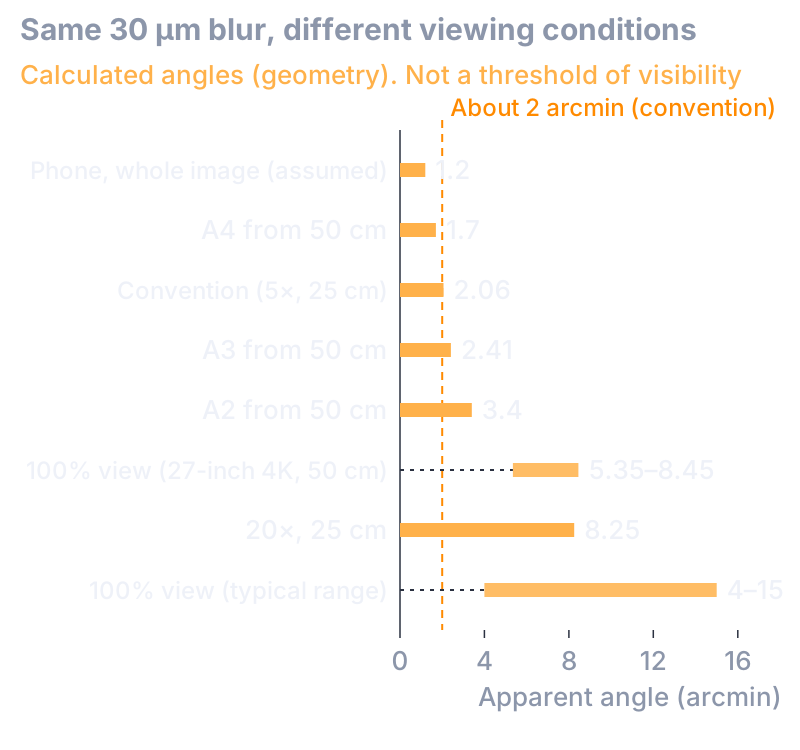
Figure 1: The apparent angle of the same 30 µm (0.03 mm) blur under different viewing conditions. These are geometric calculations, not a threshold for whether blur is visible.
Not one number has changed. Only the viewing conditions have.
Why I Stopped Looking at 100%
The habit of checking at 100% continued for a long time after that.
I think I stopped around the time of the Pentax K-1.
The reason is fairly simple. At 100%, you can only see part of the image. Just because that part fails, what about the image as a whole? If it is somewhere that is allowed to be out of focus, it doesn't matter. You could call it a side effect of rising pixel counts.
The other reason is that autofocus got better. In a mountain landscape, everything is at infinity, and at f/8 you hardly ever miss. Star landscapes I shoot wide open, but I focus manually with a magnified live view at the time of shooting, which in a sense is more precise than AF.
These days, when I do a final check of sharpness on a photograph meant for a large print or for delivery to a client, I go to 100% only where it matters.
Lined up like this, the conditions under which I checked focus have changed three times.
A 3.5× loupe. 100% on a monitor. 100% only where it matters.
In all that time, the circle of confusion stayed at 0.03. It never changed once.
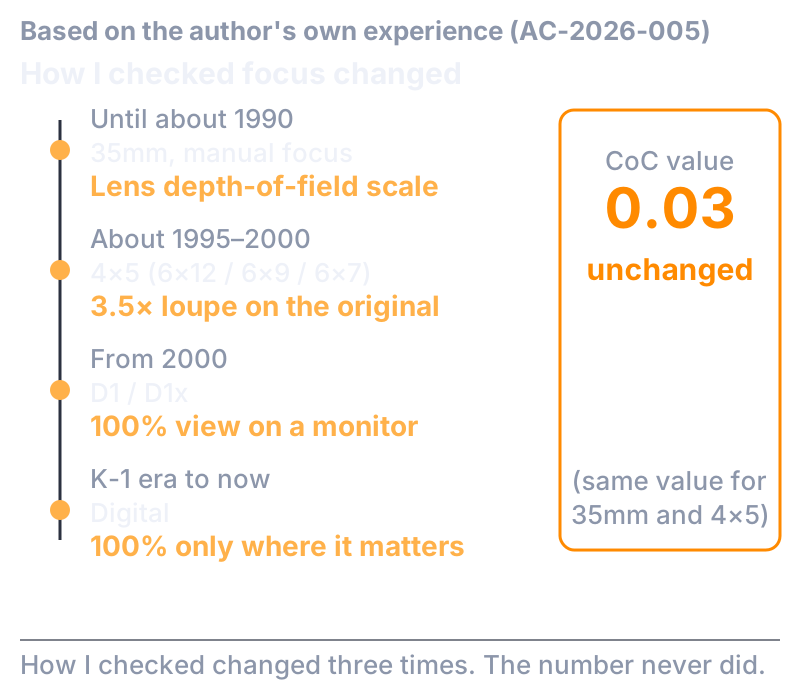
Figure 2: How the conditions under which I checked focus changed (a figure based on my own experience). The depth-of-field scale on the lens, a 3.5× loupe, the 100% view on a monitor, then 100% only where it matters — the conditions changed, but the circle of confusion stayed at 0.03.
From How Far Away Is a Print Actually Viewed?
So far, this has been about how I looked. But the people who look at a photograph — from how far away do they look?
Purely geometrically, if viewing distance scales with print width, the same blur subtends the same angle. Enlarge more, stand farther back. On that reasoning, the 0.03 mm convention applies to any size.
But the distance from which people actually view prints has been measured, and it does not grow in proportion to size. In a study that measured how far away people view photographic prints hung on a wall, for diagonals from 7 to 120 cm, the preferred distance followed "1.3 × diagonal + 25.3 cm" (measured with young adults). In other words, there is an intercept of about 25 cm even for small prints, and the distance doesn't grow that much for larger ones. Measurements in an art museum showed the same tendency: when the area of a work was twelve times larger, viewing distance was only about 1.4 times greater.
Apply this to 0.03 mm, and the angle of the same 0.03 mm blur grows gently as prints get larger. Because people don't step back in proportion.
On the other hand, you can't say either that "large prints are meant to be viewed up close for the detail." One study found that even for museum works that call for close inspection, the people who went right up to them were a minority. That said, no study has measured the same thing for exhibitions of photographic prints.
I myself go up close. That experience of stepping up to my own 1 × 2 m print and thinking "soft" is exactly that. But that is because I made it; it isn't how people generally look.
One more thing: the print itself adds blur. Comparing published measurements, the blur added by the printer and paper can be of the same order as a 0.03 mm blur enlarged to A4. Which of the two dominates switches with the paper, the printer, the size and the distance. That is a whole article in itself, so here I will only say this: a print is not transparent. I have since written that article: “Can You Really See a 0.03 mm Blur in a Print?”
The Eye That Judges Is Part of the Conditions, Too
So far it has been about output and distance. What remains, at the end, is the eye doing the looking.
Today, without reading glasses, I can't judge the focus of a print. I have been using reading glasses for about ten years, and in dim light they are essential. My eyesight is worse than when I was young.
That is a clear difference.
A photographer once told me a story. They had been saying to their photo club, "Nobody's focus is very good lately." Then one day they got new reading glasses — and everyone's focus was fine. The problem had been their own eyes.
Something of that kind is happening to me, too — at the very least, "the conditions on the viewing side are not what they used to be." Without reading glasses, I can't properly judge the focus of a print.
That said, I myself put the reason I worry less about focus than I used to down to technique and camera performance, not eyesight. When I was young, I focused manually and then recomposed, so I was always aware that focus might shift. Today's autofocus almost never misses on a landscape. And apart from outright mistakes, I don't think I am shooting soft frames in the first place.
But if I were shooting with the old gear, the decline in my eyesight might be fatal. The gear is simply making up for it.
From the research side, there are things that can be said here, and things that cannot.
What can be said: the "one arcminute" behind a visual acuity of 1.0 (20/20) is the angle for resolving the detail on an eye chart. It is not a threshold for perceiving blur. You cannot calculate a circle of confusion from visual acuity.
With age, the pupil gets smaller and the eye's depth of focus increases, contrast sensitivity for fine patterns falls, and light scatter inside the eye increases; this is known from population studies. At the same time, there is one report that healthy, corrected visual acuity stays roughly constant into the mid-50s, and another that tolerance of blur showed no relationship with age, within the range up to 46 years old.
And no study has directly measured, with photographic blur, whether the same person becomes less likely to notice small blur as they get older.
So I can't put a number on how my own eyes have changed. All I can say is this: the conditions on the viewer's side are not constant either.
Not just output size and distance — the eye that judges is part of the conditions, too.
So, What Is Your Circle of Confusion?
Let me pull all of this together.
0.03 mm was a compression of conditions: enlarge the 35mm format about 5×, view the whole image from about 25 cm, and accept about 2 arcminutes of blur.
If those conditions are your conditions, 0.03 mm can be used as it is. If they aren't, the number is the same, but its meaning changes.
"Your circle of confusion" can be calculated only once you have declared the following four things:
- what size you output to (the print size, or the screen)
- the distance you actually view from
- how large an angle of blur you accept
- the effective enlargement from the sensor plane to the output
And the state of your own eyes, the ones doing the judging.
None of this is determined automatically by your visual acuity.
| Conditions implicit in 0.03 mm | Conditions you declare | |
|---|---|---|
| Format | 35mm format (43.27 mm diagonal) | The sensor or film size you use |
| Enlargement | About 5× | Effective enlargement from the sensor plane to the output |
| Viewing distance | About 25 cm | The distance you actually view from |
| Acceptable angle | About 2 arcminutes | The angle of blur you accept |
| Way of viewing | The whole image | The whole image, or inspecting a part (at 100%) |
| Observer | Implicit viewing assumption | Your own viewing condition (with correction or reading glasses, if used) |
Table 1: How the conditions implicit in the number 0.03 mm correspond to the conditions you declare in order to calculate "your circle of confusion." The left column is a reconstruction of the convention, not a recommendation.
Looking back, my 3.5× loupe, the 100% view for the magazine CD-ROMs, and today's "100% only where it matters" were each a declaration.
Back then, I didn't know I was declaring a condition. That's all.
As a tool for the calculation, there is Sidekick Lab's Depth of Field Calculator. Its default circle of confusion is "Traditional 30 µm," but that is a reference value, and you can edit it to your own. Changing the sensor format does not change this value automatically — because it is not a number for the calculator to decide. The assumptions behind the calculation are described under "About this calculation."
Test It Once, Then Decide Whether to Trust It
I first began to question 0.03 perhaps 10 or 20 years ago. It was no more than a hunch that "this probably changes with the format."
A document I was shown at the time by someone connected with PENTAX used a value different from the usual 0.03 mm. More than that, I could not learn.
That "not knowing" stayed in the back of my mind, and this time, now that AI has made this kind of deep investigation possible for me, I looked into it. That is this article.
What I found was not whether 0.03 mm is right or wrong. It was that behind the number 0.03 mm, there were viewing conditions.
There is no need to throw the number away. 0.03 is still usable.
But 0.03 is not always the right number. Test it once against your own conditions, and then decide whether or not to trust it.
A circle of confusion is not decided by a number alone. What is being viewed, at what size, from what distance, by whom, and how? Only once those conditions are attached can you think about what the number means.
For more than 25 years, I used 0.03 without asking whose number it was.
So let me end by turning the same question back to you.
What is your circle of confusion?
Related articles: Is f/8 Really the “Best” Aperture? / When Did My "8 Seconds" for Freezing Stars Become Outdated?