Fifty years later, I looked into the aperture my father taught me.
The first time I took photographs with an SLR was around 1977–78, when I was in the second year of junior high.
It wasn't my camera. I was borrowing my father's. As I remember it, it was a Nikon EM, a small aperture-priority AE SLR, loaded with ISO 100 film. I'd take it along to school events and family trips — that kind of use.
What my father taught me about shooting came down to almost a single sentence.
“Shoot at f/8. On rainy or cloudy days, f/5.6, because the camera shakes more easily.”
I never asked why. Or rather, at the time it never occurred to me to wonder why. I just shot at f/8, as I'd been told.
There's one thing I want to make clear here.
I have no memory of my father ever explaining that “f/8 is the aperture where a lens performs best.” He loved cameras, but as far as I can recall, he almost never talked about lens performance.
So for me, f/8 started out as a number whose reason I didn't know.
That was about 50 years ago.
I've been photographing continuously ever since, and I've used lenses on the order of several hundred. And now that AI has made this kind of investigation possible for me, I decided to go back and look into it properly.
“Is f/8 really the aperture that gives the best image?”
Let me say up front that this article doesn't conclude that my father's advice was right, or that it was wrong. He never gave a reason in the first place, so there's nothing to evaluate.
But once I started looking, the story around this number, f/8, turned out to be far more interesting than I had expected.
“f/8” and “Two to Three Stops Down” Aren't Just My Story
I bought my own camera as an adult, around 1986. At first the motive was no more than “I'm going on a trip with friends.”
By around 1990, though, I was heading out with photography itself as the goal — “I have a camera, so I might as well go shoot in Kamikochi.” I added lenses little by little, read photography magazines, had long conversations at camera shops, and collected Nikon lens catalogs to pore over.
It was probably around then that I came across the idea that “a lens gives its best image when stopped down two to three stops from wide open.”
Was it a magazine? A camera-shop clerk? A catalog? Honestly, I don't remember where I first saw or heard it. But in the photographic culture of the time, it was simply common knowledge in circulation.
It still is. For example, the technical documentation of a lens-measurement software maker contains a statement to the effect that a lens tends to have its optimum aperture typically around two to three stops below its maximum aperture. For an f/1.4 lens that means f/2.8–f/4; for an f/4 zoom, f/8–f/11. “Two to three stops” and “f/8” are numbers that often turn up side by side in the same conversation.
I'll confess, though, that back in 1990 I didn't care much about a lens's “performance.”
What I cared about was mostly the amount of background blur I could get from the maximum aperture. I almost never went hunting for the optimum aperture — “does this lens resolve best at f/5.6 or f/8?” f/8 was simply the aperture I used when there was no particular reason to use anything else, and somewhere along the way it became second nature.
What Does “Best” Actually Mean?
Before going further, there's something we need to sort out.
What does “gives the best image” actually mean?
When you think about it, when we say a photograph “looks good,” we're using one phrase for quite a few different things:
- how finely detail is rendered on the plane you focused on (resolution)
- whether everything from foreground to background that needs to be in focus is in focus (depth of field)
- how much the background blurs, and how
- whether you can get a shutter speed that avoids camera shake and motion blur
- how the image looks in print or on screen
- and whether it's the photograph you wanted to make
When people say “f/8 gives the best image” or “stopping down two to three stops gives the best image,” they mean the first of these: how finely detail is rendered on the plane of focus.
In this article, that's the sense of “best” I'll investigate first. I'll come back to the other senses in the second half.
An Ideal Lens With No Aberrations Is Best Wide Open
This may sound surprising, but it's the clearest place to start.
Lenses have “aberrations,” which arise from their design and manufacture. I'd long known, as theory, how aperture relates to image quality, and I knew the words aberration and diffraction. But that knowledge stayed conceptual, and this time I ended up working through it step by step.
Suppose, hypothetically, we had an ideal lens with no aberrations whatsoever.
With that lens, the rendering of fine detail on the plane of focus is best wide open, and gets a little worse the further you stop down.
The reason is “diffraction.” When light passes through the aperture opening, it spreads slightly. No lens, however superb, can avoid this, and the smaller the opening, the greater the spread. There's no threshold where diffraction “starts at f/11” — it's happening at f/1.4, and it's happening at f/32. It just grows as you stop down.
Calculate this ideal lens and you get a single, gently falling curve. f/8 is merely one point along it. There's nothing special anywhere.
In other words, in an ideal lens, the phenomenon of “getting a little better when you stop down” simply doesn't exist.
And the values for this ideal lens are the “upper bound” for any real lens. At the same aperture, no real lens renders finer detail than this.
But a Real Lens Can Be Soft Wide Open
So why do people say that stopping down improves things?
Because a real lens is not an ideal lens.
In a real lens, aberrations can limit the rendering on the plane of focus near maximum aperture. ZEISS's technical documentation, for example, shows a 50mm lens whose measured resolution figures rise substantially across the board when stopped down from f/2 to f/5.6, and measurements of an 85mm f/1.4 lens (Planar 1.4/85) in which the highest figures came at f/8, falling off again the further the lens was stopped down beyond that.
Because examples like these exist, many people have the experience that “wide open is soft, stopping down makes it better.”
But it's “can be,” not “always is.” The amount and kind of aberration differ from design to design, and copy-to-copy variation has been reported even within the same model.
Why Stopping Down Helps
Stopping down means using only the light that passes near the center of the lens and discarding the light that passes through the outer zone.
Most lens aberrations grow larger the further out the light passes through the lens. So when you stop down and cut off the outer zone, the influence of aberration decreases. A point that smeared wide open tightens up when you stop down. That, roughly, is the mechanism behind “stopping down makes it better.”
But stopping down does not make aberrations disappear.
What decreases is the influence of aberrations concentrated in the outer zone. Some aberrations, such as distortion and lateral chromatic aberration, barely change no matter how far you stop down.
The Price: Diffraction Keeps Growing as You Stop Down
Here the ideal-lens story comes back. While stopping down reduces the influence of aberration, the spread caused by diffraction keeps growing the further you stop down. The influence of aberration falls off quickly once the outer zone is cut off, but diffraction keeps increasing without end. So as you keep stopping down, at some point the effect of “growing diffraction” overtakes the effect of “shrinking aberration.”
From there on, the further you stop down, the worse the image gets. What happens when you stop down to f/16 or f/22, and how to weigh that against depth of field, are topics I plan to cover in a separate article. For now, just hold on to this: the further you stop down, the more diffraction grows.
So a Peak Can Appear in Between — But Its Position Isn't Fixed
Aberration on the wide-open side, diffraction on the stopped-down side.
Where these two effects collide, a “peak” in the rendering of the plane of focus can appear. The rules of thumb — “stop down two to three stops for the best image,” “f/8 is best” — are talking about this peak.
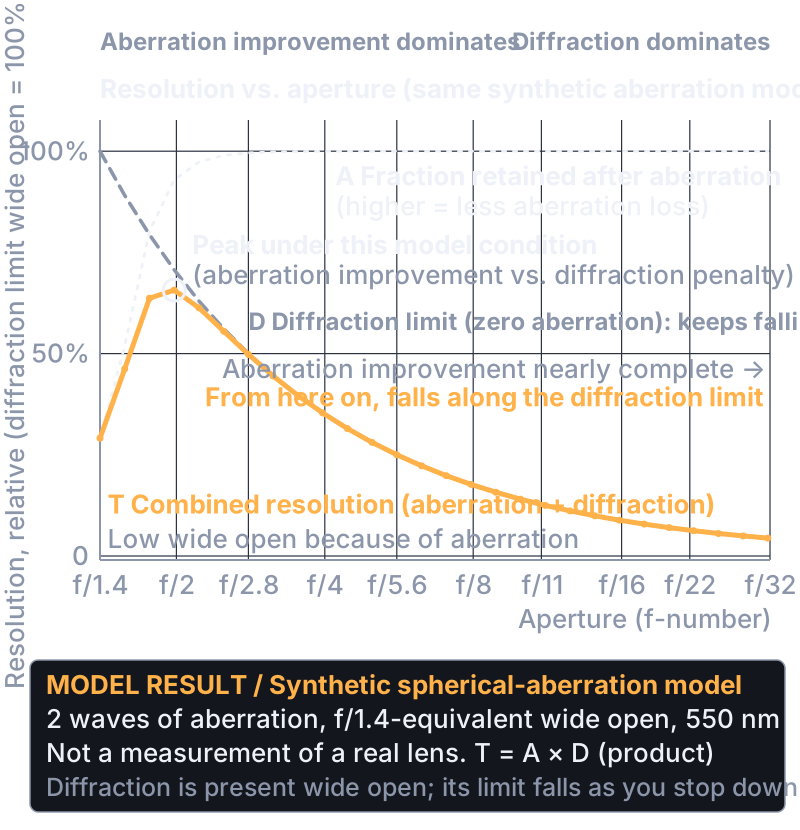
Fig. 1: Why a “best-performing zone” can appear partway through the aperture range. The three curves were calculated with the same synthetic spherical-aberration model as Fig. 2 (2 waves of aberration, in units of wavelength; f/1.4-equivalent wide open; 550 nm), shown relative to the diffraction limit wide open = 100%. D (the diffraction limit) is the upper bound of an ideal lens with zero aberration; diffraction is present from wide open and the limit falls continuously as you stop down (it doesn't “start” anywhere). A (the fraction retained after aberration) is the ratio of what remains relative to the diffraction limit at the same aperture: low wide open, rising as you stop down. T (combined resolution) is their product, T = A × D: wide open, aberration limits performance; at small apertures, diffraction does; and in between, where aberration improvement and the diffraction penalty compete, T peaks. Once the aberration improvement is essentially complete, T simply falls along the diffraction limit. This figure is a model calculation, not a measurement of a real lens. The peak position is specific to these model conditions and moves with the amount and type of aberration (Fig. 2). Nor does the crossing point of A and D mean the optimum aperture. “Aberration” here means aberrations whose effect can decrease when you stop down (it does not include distortion or lateral chromatic aberration, which don't change with aperture). Note: focal length itself is not a variable in this model. The ideal diffraction limit does not depend directly on focal length at the same wavelength and effective f-number. Real lenses differ in optical design and in the type and amount of aberration, so the combined curve and the aperture at which it peaks can differ.
I myself had assumed that diffraction was something that suddenly got worse beyond a certain point. Looking at these three lines, that wasn't the case. The diffraction limit falls continuously from wide open, and even after the aberration improvement is essentially complete, resolution keeps slipping, bit by bit, the further you stop down.
Looking at this, I think: stopping down without a photographic reason is a loss.
Of course, if I need depth of field, I stop down; if I want a slow shutter, I stop down. If the photograph I want has a reason, that reason comes first. How I actually decide on an aperture is something I'll come back to in the second half.
The question is where that peak appears.
This time, using a synthetic model that assumes only one representative aberration — spherical aberration — with an f/1.4-equivalent maximum aperture, I calculated the position of the peak while varying the amount of aberration. This is not a measurement of a real lens; it's a hypothetical calculation of “what if there were this much aberration.”
The result: the peak didn't settle in one place. As the amount of aberration changes, the peak moves anywhere from wide open itself to two stops down from wide open. It also shifts depending on whether you refocus as you stop down, and on what you use as your yardstick for “best.” And within the range of synthetic-model conditions I tested, there was no condition under which f/8 was the peak.
To be clear, this is the result of a synthetic model, not a statement about real lenses. Real lenses have all sorts of aberrations that aren't in the model, and their maximum aperture isn't necessarily f/1.4. As with the ZEISS 85mm above, there are measured examples where the peak came at f/8, five stops down from wide open. The very existence of such examples shows that the peak's position can't be pinned to a single place.
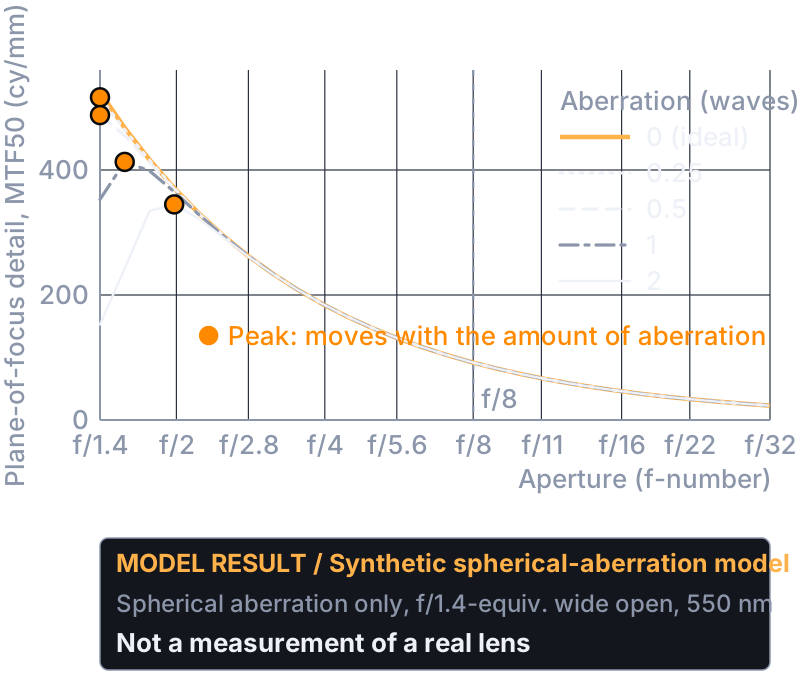
Fig. 2: Fine detail at the plane of focus (MTF50) versus aperture, calculated with the synthetic model. Spherical aberration only, f/1.4-equivalent wide open, 550 nm, refocused at every aperture (the best focus position for each amount of aberration). The orange dots mark the peak of each curve. Within the range of synthetic-model conditions tested here, there was no condition under which f/8 was the peak. That does not mean, however, that f/8 can never be the peak for real lenses in general. This figure is a model calculation, not a measurement of a real lens.
To put it another way:
A peak can exist. But where it falls moves with the amount of aberration in the lens, how you focus, and what you use as the yardstick for “best.”
“Two to Three Stops” Is a Tendency. “f/8” Can't Be Pinned Down
With all that in hand, let's look again at the two pieces of common knowledge from the beginning.
First, “a lens gives its best image when stopped down two to three stops from wide open.”
This is a rule of thumb that technical documents state with the word “typically.” In a lens where aberration dominates on the wide-open side, the peak appears somewhere after stopping down a little, so it's a tendency with a reason behind it.
But it isn't a law. In an ideal lens, the “number of stops” doesn't even exist; in a real lens, the peak moves with the amount of aberration and with your yardstick. “Two to three stops” is a rough guide that points somewhere within that moving range, not a rule that applies to every lens.
Next, “f/8 gives the best image.”
When and where the “f/8” rule of thumb became generalized is something this investigation couldn't establish. The only concrete measured example I could confirm was the ZEISS 85mm introduced above. And in that document, when actual photographs were compared side by side, the best was f/11 — and it also says that “the differences are not as large as the shape of the curves might suggest.” Even on the same lens, “best” shifts depending on what you judge it by.
In other words, I found no evidence to support an “f/8 gives the best image” that applies to every lens and every condition.
But this, too, needs to be stated precisely.
What I didn't find was a universal basis — one that “applies to every lens.” On a particular lens under particular conditions, f/8 can of course be the peak. For the measured example I was able to confirm, at least, one can say “on that lens, it was f/8.” But that's a statement about “that lens,” and it doesn't provide grounds for extending it to “every lens.”
Table 1: “How many stops down is best?” has no single answer until you fix the conditions
| Lens / source | What counted as “best” | Result | Nature of the evidence |
|---|---|---|---|
| Ideal lens with no aberrations | Fine detail at the plane of focus (MTF50, 550 nm) | Best wide open (0 stops down). Falls as you stop down | Calculated value |
| Synthetic spherical-aberration model (f/1.4-equivalent wide open) | Same, calculated with varying amounts of aberration and focus positions | Peak between wide open and 2 stops down. Moves with the amount of aberration, the focus position and the metric | Synthetic model (not a real lens) |
| ZEISS Planar 1.4/85 (manufacturer's technical document) | Measured MTF | f/8 (5 stops down from wide open) was highest | One measured example |
| Same lens | Comparing actual photographs | f/11 was best. “The differences are not as large as the shape of the curves might suggest” | One measured example (a different criterion shifts the “best”) |
| Technical documentation of a lens-measurement software maker | General tendency of the “optimum aperture” | “Typically around 2 to 3 stops below maximum aperture” | Description of a tendency (neither a law nor a recommendation) |
A calculated value, a synthetic model, one measured example and a description of a tendency are different kinds of information. They sit in the same table for comparison, not because any one of them is “the right answer.”
So what if, instead of the fixed number f/8, you count in relative terms — “two or three stops down from wide open”? Can that rule find the best-performing aperture for any lens? I looked into that rule of thumb in the next article, Is a Lens Really at Its Best 2–3 Stops Down?
When the Number Outlives Its Reasons
Here, let me return to my father.
My father said, “Shoot at f/8,” but he never said why.
In later years, I came to interpret it this way: with manual focus, it covers a bit of focusing error; it secures depth of field; and the lens renders consistently. As a setting for a beginner, f/8 could have had all kinds of practical meanings.
But that's my interpretation. Whether my father thought it through that far, I have no way of knowing.
What matters is this: when the reasons aren't passed on and only the number survives, that number loses its conditions and takes on a life of its own.
“Two to three stops” had reasons behind it — aberration and diffraction. Where the number “f/8” became generalized, on the other hand, is something this investigation couldn't establish. Even so, once the reasons and conditions fall away and only the number is left, it can start to look like a rule before anyone notices. It starts to wear the face of “any lens” and “any photograph.”
The same thing seems to me to be happening, for example, with the saying “f/22 for mountain photography.” I intend to write about that in a separate article, together with what actually happens when you stop down to f/22.
Nor is this limited to aperture. I myself used the 35mm-format circle of confusion, 0.03 mm, for more than 25 years without ever asking what conditions that number assumed. I wrote about that in “What Is Your Circle of Confusion?”
So How Do You Choose an Aperture? Start With the Photograph You Want
When I critique or teach photography, I don't tell people to “shoot at f/8.”
The first thing I ask is always this:
“What do you want to photograph? What's the picture in your head?”
Do you want the background blurred right out? Do you want everything in focus from front to back? Do you want to render flowing water with a slow shutter? Do you want to freeze a moving subject without blur? Or do you want to pan with it?
If there's a purpose in that picture that involves aperture, the aperture follows from it. Want blur — open up. Want focus all the way back — stop down. Need a faster shutter speed — open up.
How far you need to stop down to get the range you need in focus can be calculated from focal length, f-number and shooting distance. With Sidekick Lab's Depth of Field Calculator, you can see on the spot how depth of field changes as you change the aperture.
By around 1990, I was already switching between wide open, f/8 and f/22 according to purpose. There was a period, for instance, when I liked stopping a 20mm f/2.8 down to f/22, putting the sun in the frame and deliberately producing ghosting. Not “I don't use f/22 because diffraction makes it soft,” but “this photograph needs f/22,” so I use it. That's all there is to it.
For portraits and astrophotography, I shoot wide open.
And when I feel that the rendering wide open isn't good enough, what I do is not “stop down a stop or two to improve it.” I switch to a lens that gives me the rendering I need wide open. For a photograph that needs the maximum aperture, an assessment like “it gives its best image stopped down to f/2.8” doesn't mean much.
To be honest, maximum resolution sits fairly low on my list of priorities when I'm shooting. When I come across a lens with soft rendering, more often than not I take it as “that's the kind of lens this is.” Compared with getting the depth of field I need or avoiding unwanted blur, maximum resolution can wait. That's how I photograph.
I Still Shoot at f/8 Unless I Have a Reason Not To
So what do I do when there's no particular purpose?
I've used lenses on the order of several hundred, but I don't operate by memorizing “this lens performs best at f/such-and-such” for each one. Fast prime or slow zoom, the basic approach is the same.
If there's no reason to choose otherwise, f/8.
This has been my basic practice, unchanged, since junior high.
And after finishing this investigation into f/8, that practice hasn't changed. In my own words, it goes like this:
“Maybe I want to blur the background, or get everything sharp from front to back, or use a slow shutter, or avoid blur, or pan with the subject… If there's no reason to choose otherwise, f/8.”
Just to be clear, this isn't something I decided because I looked into it this time and understood the reasoning. It's simply that what I'd been doing all along didn't change after I looked into it.
“f/8 Is the Best Aperture” and “f/8 Unless I Have a Reason” Are Two Different Things
If you've read this far, I think it's clear that these are two different propositions.
“f/8 is the best aperture” is a claim about lens performance. As a statement that applies to every lens, I found no evidence to support it. A peak can exist, but its position moves with the lens and the conditions. There are lenses for which f/8 is best, and lenses for which it isn't.
“f/8 unless I have a reason” is my practice when I shoot. If the photograph I want gives me a reason to change the aperture, I follow that reason; if there's no reason, I use f/8 as the starting point. This isn't about lens performance. It's about the order in which you decide the aperture.
Whether the “shoot at f/8” my father taught me around 1977–78 was scientifically correct, I don't know. He never gave a reason, and I never asked. What I did learn, looking into it about 50 years later, is that “because f/8 gives the best image” is not a reason that can hold that advice up.
Even so, I expect I'll go on shooting at f/8 when there's no reason to choose otherwise.
If you're looking for “the aperture that gives the best image,” there's one thing to settle first.
What is it you want to render well?
Choose the aperture from the photograph you want. If there's no reason to choose otherwise, f/8.
For now, that's my answer.