After f/8, I questioned another “best aperture.”
In the previous article, I looked into the “shoot at f/8” my father taught me. I found no evidence that f/8 is the aperture where every lens performs best.
But there is one more piece of “best aperture” common sense that I remember.
A little before I started going out to photograph landscapes with my own camera, I remember hearing at a camera shop that “a lens performs best when you stop down two or three stops from wide open.” I don't remember who said it, or which shop. But the two pieces of advice never really conflicted for me.
The reason is simple. Back then, I was buying modest f/2.8 primes for landscapes. In landscapes you rarely use a shallow plane of focus, and you don't need f/1.4. An f/2.8 prime is cheap, light and small — a kit you can carry and shoot with all day. That was my set.
Stop an f/2.8 lens down two stops and you get f/5.6; three stops, f/8. So with my gear, “f/8” and “two or three stops down from wide open” pointed to almost the same place.
But maximum apertures vary. There are f/1.2 lenses and there are f/5.6 lenses. Does counting “two or three stops down from wide open” tell you where those lenses perform best, too?
Turning “2–3 Stops” Into f-Numbers
First, the arithmetic — nothing else.
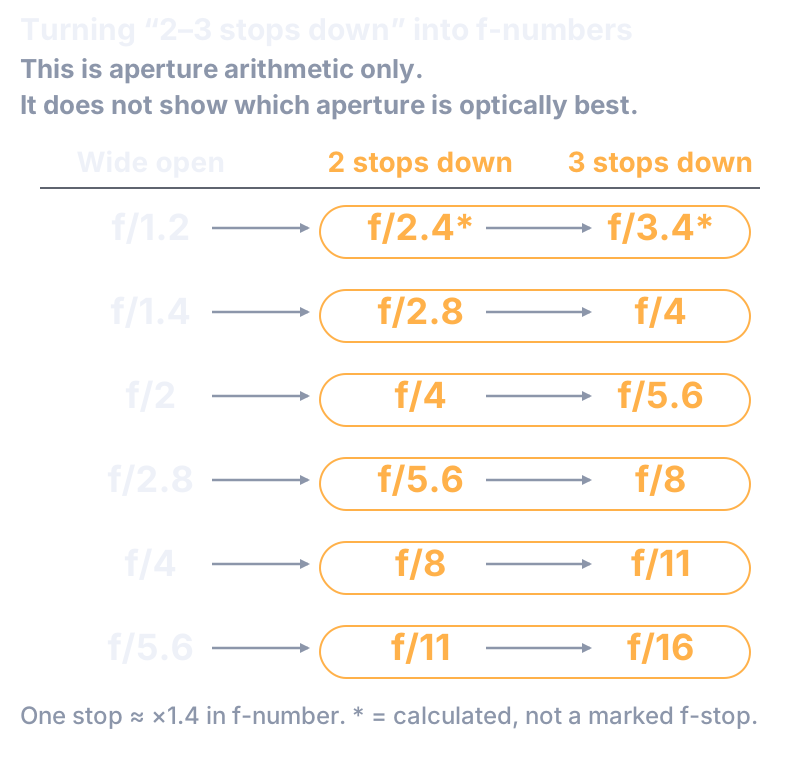
Fig. 1: “Two to three stops down from wide open,” converted to f-numbers for lenses with different maximum apertures. One stop multiplies the f-number by about 1.4, so two to three stops down from f/1.2 is f/2.4–f/3.4, and from f/5.6 it is f/11–f/16. This is aperture arithmetic only. It does not show which aperture gives the best image.
The same “two or three stops” is f/2.4–f/3.4 on an f/1.2 lens, f/5.6–f/8 on an f/2.8 lens, and f/11–f/16 on an f/5.6 lens. In absolute f-numbers, they point to completely different places. But note that this chart says nothing about which aperture is best. It only translates the rule into f-numbers, lens by lens — and the translations come out this different. That is the first thing I want you to see.
Let Me Give the Answer Here
“A lens performs best two or three stops down from wide open” — what is often called the lens's “sweet spot” — is a useful rule of thumb. But it is not a law of optics that applies to every lens. And it does not decide the aperture you should use for a given photograph.
I won't call it wrong. On a lens where aberrations limit the image near wide open, and where a couple of stops down still leaves diffraction small, two or three stops can be a reasonable rule of thumb. But I won't call it mostly right, either. In the measured examples I checked, the best-performing aperture scattered from near wide open to nearly five stops down — and even within one lens, it changed depending on where in the frame you look.
Let me go through why, step by step.
Stopping Down Can Help — A Recap of the Previous Article
I wrote out the reasoning in the previous article, so here I'll compress it into four sentences.
Real lenses have aberrations, and near wide open those aberrations can limit how the plane of focus is rendered. Stopping down stops using the light that passes through the outer part of the lens, so the influence of aberrations concentrated out there can decrease. At the same time, the spread caused by diffraction is there from wide open and keeps growing as you stop down. So where the decreasing aberrations and the growing diffraction cross, a “best-performing zone” can appear — and where it sits moves with the lens and with what you measure.
The rule of thumb “stop down two or three stops and the lens performs best” is talking about this zone in between. Up to here, nothing is different from the previous article.
So Why Would “2–3 Stops Down” Be Special?
This is the heart of the article.
At ordinary shooting distances, the amount of diffraction is set by the actual f-number. f/8 gives you f/8's worth of diffraction. Whether that lens opens up to f/1.4 or to f/4 makes no difference to the diffraction.
The amount of aberration, on the other hand, is set by the lens design. How much remains wide open, what kind it is, and how much it drops as you stop down — that differs from one lens to the next.
Seen in terms of focal-plane sharpness, the “best-performing zone” is set by the balance between these two. One side is fixed by the absolute f-number; the other differs from lens to lens. If that is so, why would the point where they balance land at the same distance from wide open — “two or three stops” — on every lens?
In what I looked at, I found no mechanism that would make it so. Counting stops from wide open is correct as aperture arithmetic, and useful as a rule of thumb. But the optics don't put the best aperture there for you.
Measure Them, and They Scatter
So what about real lenses? This time I went through existing measurement sources.
The Canon EF 50mm f/1.8 STM, for example, peaked at f/4 in one test site's center-resolution measurements — a little over two stops down. That one is close to “two or three stops.”
The ZEISS 85mm f/1.4 from the previous article, on the other hand, gave its highest value at f/8 in the manufacturer's measurements — five stops down. And going the other way, among f/2.8 standard zooms there are examples whose center values are already close to their best within one stop of wide open.
Put the measured examples I checked together, and the best-performing apertures scatter from near wide open to nearly five stops down. Some fall inside “two or three stops”; some fall well outside it. I can't say how many lenses out of how many did what. But even within this range, one thing can be said: it is not “every lens at two or three stops.”
Even in One Lens, “Best” Depends on Where You Look
There is one more example that surprised me.
The Tokina 56mm f/1.4 (for APS-C), measured by one test site under the same conditions, was best at the center of the frame at f/2.8 — two stops down. But the outer part of the frame, the outer field, was best at f/5.6–f/8 — four to five stops down. One lens, one test, and the “best” for the center and for the outer field were two to three stops apart.
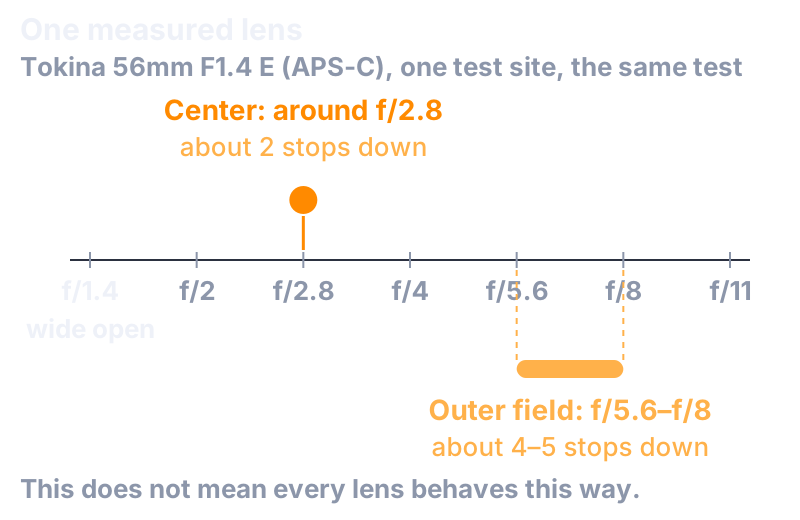
Fig. 2: One measured lens. The aperture where the center of the frame was best and the aperture where the outer field was best were different within the same test (Tokina 56mm F1.4 E, measured by one test site). This is one lens. It does not mean every lens behaves the same way.
It is one example, but what it shows matters. The question “where does this lens perform best?” has no single answer until you decide where in the frame you are looking.
Let me go back to my own past here. The landscapes I shot back then were focused at practically infinity. I used f/8 all the time, but not because I needed the depth of field. What I cared about was whether the picture came out crisp or soft. I often printed at hanseki — roughly 14 × 17 inches — and at that size, I think I could notice when focus was slightly off or the image lacked bite. Shots taken wide open didn't come out crisp — that was the impression I had. It is an impression from that time, not a measurement.
I Wasn't Shooting by the 2–3 Stop Rule
I'll admit it: even after I learned “two or three stops down from wide open,” I wasn't shooting by that rule.
With the f/2.8 landscape lenses, yes, I used around f/8. But in the same period, I kept a 50mm f/1.4 for shots I deliberately wanted to blur, and I thought of the 85mm f/1.4 as a lens to use wide open, and basically used it wide open. Two or three stops down from f/1.4 is f/2.8–f/4. I have almost no memory of using it there.
So I knew the rule, and I even accepted it — but in practice I was choosing the aperture, lens by lens, by what I wanted that lens to do. With the f/2.8 lenses, that just happened to coincide with “two or three stops.”
A Lens's Best Aperture and the Aperture for This Photograph Are Two Different Things
“Where does this lens perform best?” and “what aperture does this photograph need?” are two different questions.
The first has an answer if you measure — but only once you have decided what “performs best” is measured by, where in the frame you look, and how you focus; and the answer differs from lens to lens. The second is decided not by the lens but by the photograph you want to make.
In my case, it goes like this. If I want blur, I open up. When a star landscape needs light, I open up too. For landscapes, I decide the aperture from the depth of field that picture needs. I don't stop down further than I have to, but if depth of field matters more, I accept the cost in diffraction. If the purpose of the photograph already points the aperture in a direction, I go straight there. That's all.
So what about “two or three stops down from wide open”? I think it's fine to use. But it is a default, not a final answer — a reference point, something to fall back on when nothing about the photograph you want makes a stronger claim on the aperture. If you already know what the picture needs, there is no reason to set the lens two or three stops down first and then move away from it. That is a pointless detour.
Nobody walks into a restaurant and asks, “Chef, what do I feel like eating?” What you want to shoot is something you decide for yourself.
The “best aperture” is like the chef's recommendation. You can order it. But you don't have to. If sushi is the recommendation and what you want is tamago kake gohan — rice with a raw egg — then have that.
The photograph, not the lens, decides the aperture.
For Those Who Want to Go a Little Deeper
Everything you need for shooting is complete above. What follows is for those who want a closer look at the places where the main text said “it depends on what you measure” or “it depends on the lens.” There are no new claims here.
The Criteria Behind “Performs Best”
“The aperture where a lens performs best” does not become a single number until you have decided at least the following.
- What you measure: fine detail at the plane of focus (MTF50 and the like), contrast at low spatial frequencies, or the resolving limit. Change the criterion, and the best aperture shifts even for the same lens.
- Where in the frame: center, mid-frame, or outer field. As with the Tokina in the main text, the center and the outer field can have different best apertures.
- How you focus: whether you refocus at each aperture or keep the focus set wide open. On some lenses the focus position moves as you stop down, and the ranking changes.
- How you view it in the end: the sensor's pixels, the processing, the print or screen size and the viewing distance all change whether a difference is visible at all.
You cannot average these into one “best f-number.” Which one to prioritize is decided by the photograph you want.
The Measured Examples I Checked
Here are the measured examples I could check, including the ones mentioned in the main text. Test sites and manufacturers measure differently, so I have not ranked figures from different sources against each other. Read the stops-down column only within a single source.
| Lens (source) | Max. aperture | What was measured | Best aperture in that test | Stops down from wide open |
|---|---|---|---|---|
| Canon EF 50mm f/1.8 STM (LensTip) | f/1.8 | Center resolution (MTF50) | f/4 | about 2 |
| Nikon Z 50mm f/1.8 S (LensTip) | f/1.8 | Center resolution (MTF50); high from wide open | f/4 | about 2 |
| Nikon AF 50mm f/1.8D (LensTip) | f/1.8 | Center resolution (MTF50) | f/5.6 | about 3 |
| Canon EF 50mm f/1.2L (LensTip) | f/1.2 | Center resolution (MTF50) | f/4–f/5.6 | about 3.5–4.5 |
| Sony FE 35mm f/1.4 GM (LensTip) | f/1.4 | Center resolution (MTF50); high from wide open | f/2.8–f/4 (plateau) | about 2–3 |
| Tamron 28-75mm f/2.8 G2 (LensTip) | f/2.8 | Center resolution (MTF50); varies with focal length | wide open to 1 stop down | 0–1 |
| Sigma 24-105mm f/4 Art (LensTip) | f/4 | Center resolution (MTF50) | wide open to 1 stop down | 0–1 |
| Tokina 56mm f/1.4 E (OpticalLimits, APS-C) | f/1.4 | Center / outer field | center f/2.8 / outer field f/5.6–f/8 | center 2 / outer field 4–5 |
| ZEISS Planar 1.4/85 (manufacturer technical document) | f/1.4 | Measured MTF (10–80 lp/mm) | f/8; falls from f/11 | 5 |
Table 1: The measured examples I checked. “Best aperture in that test” is limited to each source's test conditions (camera, processing, image height, focusing). Rows from different sources cannot be ranked against each other, and the table says nothing about how many lenses out of how many fall into which range.
One thing can be read from it. Even within the single criterion of “center resolution,” the best aperture ranges from wide open to four stops down or more, and fast lenses don't agree with each other. If every lens had its best aperture at the same fixed number of stops from wide open, the examples would not scatter like this.
“2–3 Stops” in the Literature
Some readers will wonder where the “two or three stops” idea came from. Here are a few of the documents I was able to check.
Among older optical references, a 1910 circular from the U.S. Bureau of Standards says that for objectives covering a wide field, as in photography, definition improves when the aperture is stopped down to half its full diameter. Half the diameter means twice the f-number — about two stops. But the phrase “two or three stops” does not appear there, and nothing in it says that this is best for every lens.
Manufacturers' documents have it too. Nikon's instruction manual for the EL-Nikkor enlarging lens tells you to stop down two or three stops for corner-to-corner sharpness when enlarging — but that is an enlarging lens, and it cannot be extended to taking lenses in general. Nikon's 2012 D800 Technical Guide says that peripheral contrast can generally improve when you stop down two or three stops from maximum aperture — while also stating clearly that the results differ from lens to lens.
Several of the documents I could check recommend stopping down in the context of the whole frame, edges included. But where the phrase “two or three stops down from wide open” first appeared, and who spread it, I could not find out in this investigation.
What This Investigation Could Not Determine
- Where the phrase “two or three stops” first appeared, and how widely it has been taught.
- What proportion of the lenses out there have their best aperture within any given number of stops from wide open (the examples here are a limited set, and no ratio can be stated).
- A complete table for a single lens, measured from wide open to four stops down at the center, mid-frame and outer field under the same conditions.
- How much sample variation, focus-position shifts and in-camera processing contribute to each individual result.
This article says only what can be said without filling in those blanks.