Shoot with Astrotracer using an ultra-wide or fisheye lens and you can find that the stars are well held at the center of the frame while, near the edges, they trail a little.
I have known about this phenomenon itself for a long time.
As I recall, back in the earliest days when I was using a K-5 and an Astrotracer prototype, Astrotracer worked normally even with a fisheye lens attached.
Look at the resulting images, though, and the stars were not perfectly held all the way to the edges.
At the time I thought
"it's a fisheye, so it can't be helped."
A fisheye lens renders things quite differently from an ordinary wide-angle lens.
Straight lines bend considerably near the edges of the frame.
Since it is a lens with such a special projection, Astrotracer — which follows the stars by moving the image sensor — presumably cannot correct all the way to the edges.
I did not think about it any further than that.
In 2026, though, I recalculated it while asking
"is it really because it is a fisheye?"
The result was the opposite of what I had vaguely assumed for years.
Compared at the same field of view, in the idealized model used here,
the fisheye lens gave a smaller tracking residual near the edges of the frame than an ordinary, non-fisheye ultra-wide lens.
Nor was there a field of view at which the relationship reversed.
I tested 16 diagonal fields of view from 5° to 165°. At every one of them the fisheye came out smaller.
So why do the stars near the edges trail at all, when Astrotracer is supposed to be following them?
As I looked into it, what sat at the center of the problem was not "because it is a fisheye."
It was how Astrotracer follows the stars.
That is where the reason lay.
Astrotracer follows the stars by moving the image sensor
As explained in Astrotracer ① "Why Do the Stars Stay Sharp While the Ground Blurs?", Astrotracer does not move the camera or the lens themselves.
The camera and lens stay fixed on the tripod.
What moves is the image sensor inside the camera.
PENTAX's SR unit can rotate the image sensor about the optical axis as well as shift it in X and Y.
So Astrotracer follows star images as they move over time using
a shift in X
+ a shift in Y
+ rotation
I understood all of that from the time I first used Astrotracer.
What I looked into again this time comes after that:
even if the X/Y shift and the rotation are performed perfectly, might there be cases where the stars across the whole frame cannot be matched exactly?
The sky lies on a sphere; a photograph is a plane
The position of a star can be thought of as a direction on the celestial sphere that surrounds us.
As the Earth rotates, the whole sky appears to rotate about the celestial pole.
So far this is all about three-dimensional directions.
But when you photograph it, the lens projects it onto a two-dimensional image plane.
In other words,
the motion of a star on the celestial sphere
and
the motion of its star image after projection onto the plane of the photograph
are not the same thing.
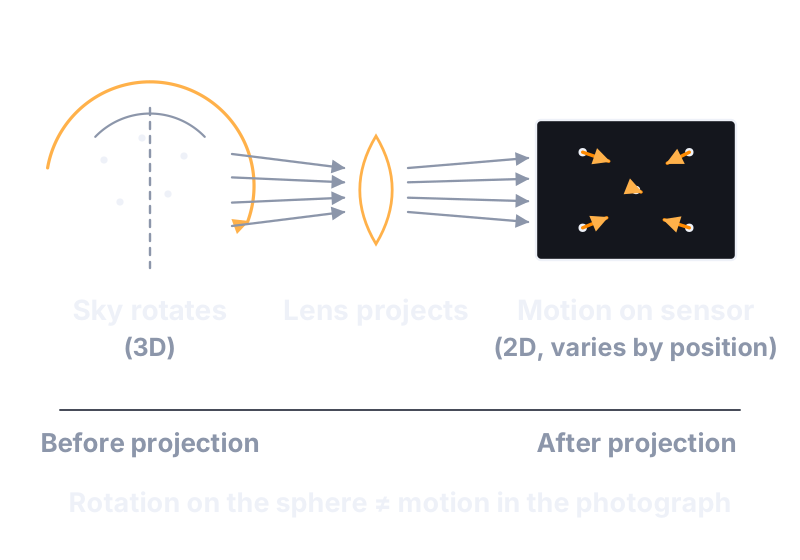
Fig. 1: The stars rotate on the celestial sphere. The lens maps that onto a plane. The rotation before projection and the motion after projection are not the same.
That turned out to be the key point.
What the image sensor can do is, essentially, shift a single plane in X and Y and rotate it.
But the result of projecting the motion of stars on the celestial sphere onto a plane through a lens generally cannot be reproduced exactly by simply translating and rotating one plane.
Match the stars at the center of the frame well, and small errors remain that grow with distance from the center.
That is the tracking residual considered here.
Put another way, the transformation that projects the rotation of the celestial sphere onto the image plane, and a planar X/Y shift plus rotation, are different things.
What the sky asks for differs from place to place in the frame
Let me show this with actually calculated star motion.
Take a 14 mm lens on full frame, and point the camera so that the celestial equator runs across the middle of the frame.
As the Earth rotates, how do the stars move within the frame?
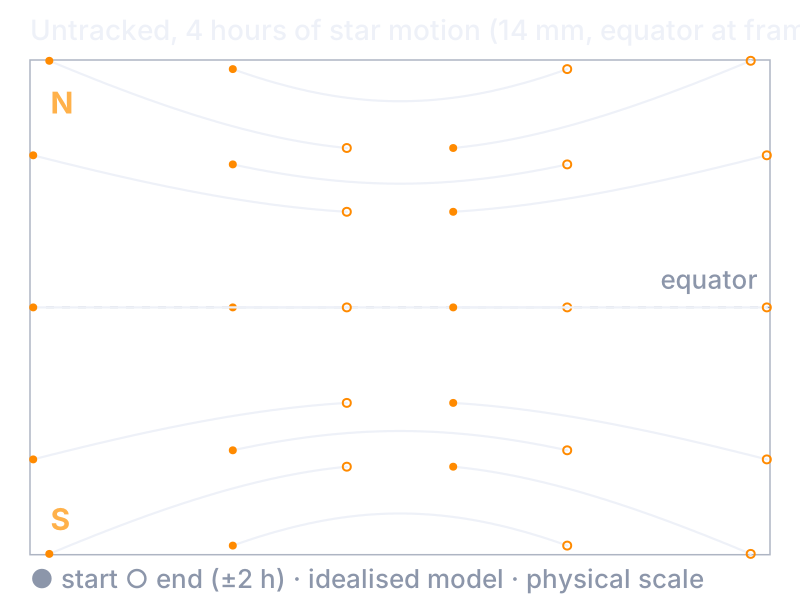
Fig. 2: Untracked star motion over four hours (±2 hours), calculated with an idealized model. 14 mm, full frame, celestial equator at the frame center, actual scale. ● marks the start, ○ the end. Stars north of the equator trace arcs curving toward the north, stars south of it trace arcs curving toward the south, and only stars on the equator move in straight lines. Not a measurement of an actual PENTAX camera.
Stars north of the equator trace arcs that curve toward the north.
Stars south of it trace arcs that curve toward the south.
Only the stars on the equator move in straight lines.
In other words, within one and the same frame, the motion the sky asks for differs from place to place. North and south, the curvature runs the opposite way.
Of course, nobody exposes for four hours. But even within 60 seconds this difference in direction exists as a small difference. In this idealized model, the star motion in the upper and lower parts of the frame contains small rotational components in opposite senses (about 3.8 arcminutes each; an arcminute is 1/60 of a degree), and on the equator that component is zero.
Track it with one sensor, and what remains?
But there is only one image sensor.
All it can do is shift in X, shift in Y, and apply one rotation.
It cannot give the upper and lower parts of the frame different rotations.
So if you track this sky with one image sensor, what remains?
I calculated the same star field, the same 14 mm, the same 60-second exposure, changing only how the sensor is moved.
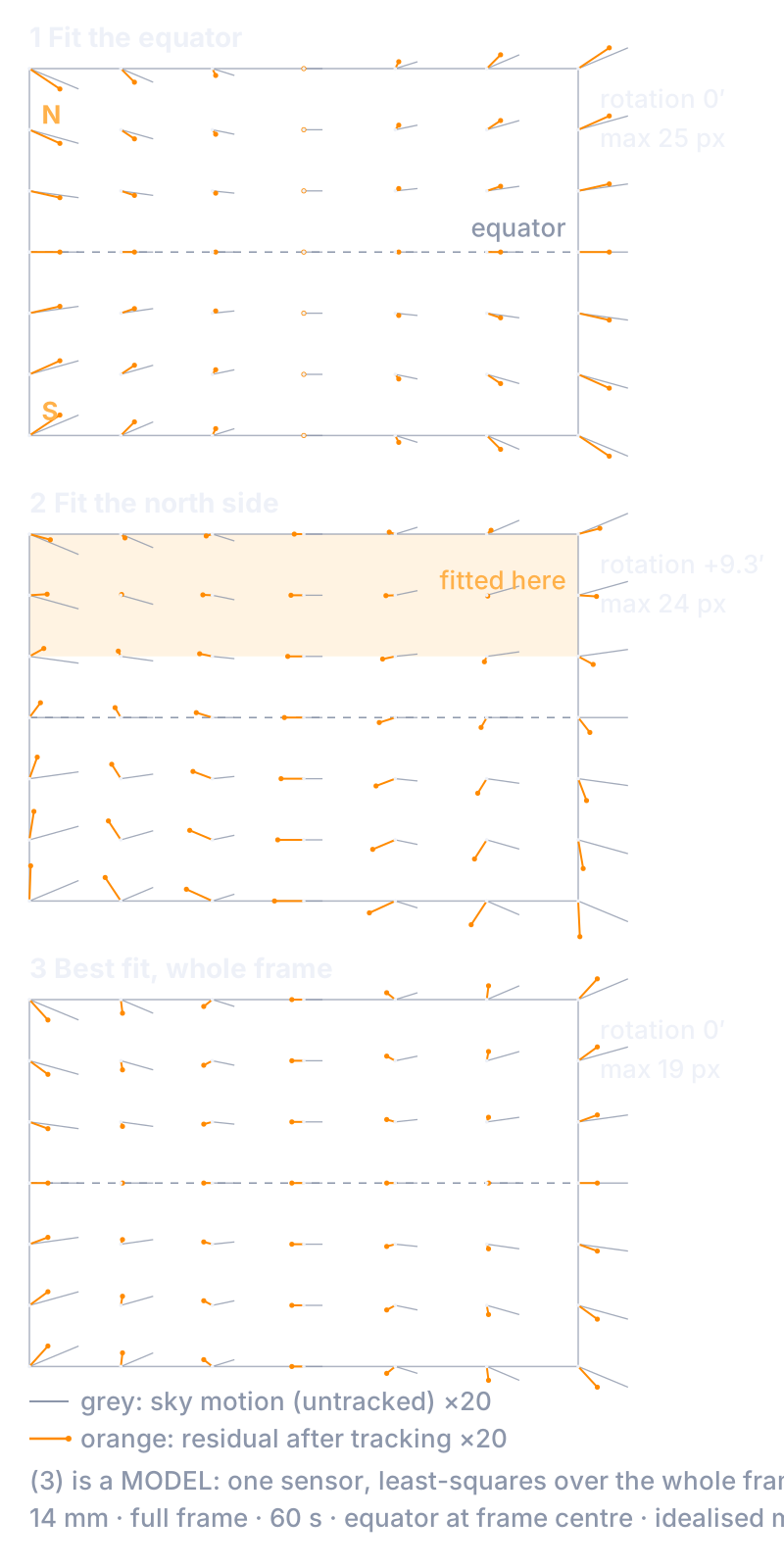
Fig. 3: Three calculations of the same star field, the same 14 mm, and the same 60-second exposure, changing only how the image sensor is moved. Gray: untracked star motion; orange: the residual left after tracking with the sensor (both shown magnified 20×). (1) Matched, with no rotation, to a point on the equator. (2) Matched with rotation (+9.3 arcminutes) to the stars in the top third of the frame (the shaded band) only. (3) The shift and rotation that minimize the error over the whole frame. (3) is a model of "one image sensor minimizing the error over the whole frame"; it does not represent the control used in an actual PENTAX camera. Idealized model; a 13×13 grid thinned to 7×7 for display.
(1) is the case with no rotation, matched only to the star at the point on the equator at the frame center.
The stars near that point are almost still, but a radial residual remains that grows toward the corners (up to about 25 px). The direction of the residual is mirrored top to bottom, north versus south.
The way stars trailed in my own Astrotracer frames looks very much like the result of (1). But a real frame also carries errors that have nothing to do with the tracking control, so this resemblance alone cannot tell us how the camera actually controls the sensor.
(2) is the case matched to the stars in the top third of the frame only, using rotation (about 9.3 arcminutes) as well.
The upper part, the one it was matched to, improves (up to about 15 px).
But the same rotation is applied to the lower part too, so the lower part gets worse (up to about 24 px).
(3) is the case where one shift and one rotation are chosen so that the error over the whole frame is smallest.
The corners come down to about 19 px, but in exchange about 8 px remains at the center too.
One interesting point here is that the rotation in (3) was zero.
In a symmetric composition with the equator through the middle of the frame, the rotation the upper part asks for and the rotation the lower part asks for cancel each other out. The difference between (1) and (3) was not the rotation but the amount of shift: (1) shifts to match the center star, (3) shifts to match the average over the whole frame. Run the same calculation for an asymmetric composition with the equator placed toward the bottom of the frame, and the rotation in (3) is no longer zero; it becomes the rotation the position of the frame center asks for.
Once again, (2) and (3) do not mean "this is how PENTAX controls the sensor."
They are a model for seeing what happens when a single image sensor can be given only one motion.
What the sky asks for differs from place to place in the frame. But there is one image sensor, and it can only shift in X and Y and apply one rotation.
That is why, at ultra-wide angles, the whole frame cannot be tracked completely.
Matched at the center does not mean matched in the corners
Suppose you shift and rotate the image sensor to match the motion of stars near the center of the frame.
Near the center, the star images can be followed quite accurately.
Toward the edges and corners, however, the difference grows between the motion of the stars projected from the celestial sphere onto the plane and the planar motion of the image sensor.
When that difference accumulates during the exposure, a star image becomes a short line rather than a point.
The thing to note here is that this is not a claim that
"they trail because Astrotracer is inaccurate."
These calculations assume an ideal state with no azimuth or tilt measurement error, no mechanical play and no vibration.
Residuals still appear.
So, at least in the idealized model, this is a geometric problem, separate from mechanical accuracy.
How large is the difference?
So how large is the residual in the idealized model?
Here I assumed a full-frame-equivalent image sensor and modeled it as a single plane that can shift in X and Y and rotate.
This does not reproduce the internal algorithm of an actual PENTAX body.
Nor does it mean
"PENTAX tracks using the stars at the center of the frame as its reference."
It is purely a model for looking at geometric behavior.
The calculation produced conditions where the residual is very small near the center of the frame while growing toward the edges.
For example, calculating full-frame 14 mm, a 60-second exposure, facing south at 40° altitude, and matching to the stars at the center of the frame: the residual near the center is only about 0.4 px, while in the corners it reaches about 23.5–23.9 px.
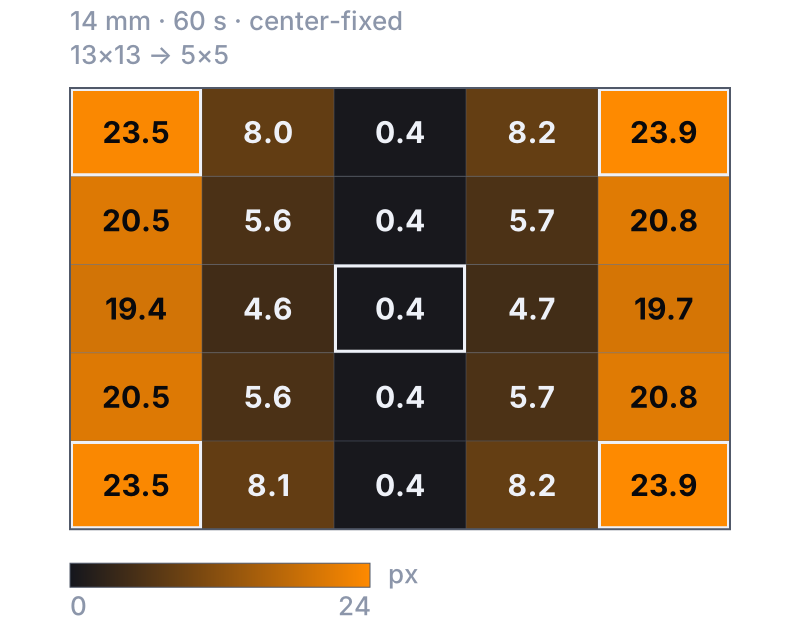
Fig. 4: Tracking residual across the frame, calculated with an idealized model. 14 mm, full frame (35.9 × 24.0 mm, 4.88 µm pixel pitch), latitude 35°, facing south at 40° altitude, 60 s exposure. Values are for tracking matched to the stars at the center of the frame (center-fixed), computed on a 13×13 grid and shown thinned to 5×5. Not a measurement of an actual PENTAX body.
In other words,
the stars being held at the center does not mean the stars across the whole frame are held to the same accuracy.
With ultra-wide lenses this becomes easier to see.
The issue is "field of view" more than "focal length"
There is another important point here.
When you hear that
"the wider you go, the more the stars near the edges trail,"
you might think
"so it is because the focal length is short."
Essentially, though, what matters is not the focal length itself but how wide a region of the sky you are mapping onto a single plane.
That is, the field of view.
Over a narrow region, approximating a piece of a sphere with a plane does not produce much difference.
The wider the field of view, the larger the difference produced by projecting the sphere of the sky onto a single plane.
It is the same as a map.
For a very small region of the Earth, a flat map causes little trouble.
Try to put the whole Earth on one flat map and distortion appears somewhere.
Something similar happens with the sky.
So rather than
"it trails because it is N mm,"
it is closer to the truth to think
"how wide a field of view are you mapping onto a plane, and with what projection?"
So is a fisheye even worse?
Here I come back to the question I had vaguely held for years.
Fisheye lenses.
Shoot with a fisheye and straight lines bend considerably near the edges of the frame.
The image is clearly different from an ordinary ultra-wide lens.
So I assumed
"a fisheye is a special projection, so it must be even worse for Astrotracer."
The calculation gave the opposite result.
What I compared was
an ordinary, non-fisheye ultra-wide/wide-angle lens
— the type that renders straight lines as straight lines
against fisheye lenses.
Ordinary wide-angle lenses normally use rectilinear projection.
Fisheye lenses have several ways of deciding where an angle in the sky is mapped on the sensor. What I calculated here were the three projections
equidistant projection
equisolid-angle projection
stereographic projection
And I compared them with conditions matched so that the diagonal field of view was the same.
At the same 114 degrees, the fisheye had the smaller residual
As one example, let me compare at a diagonal field of view matched to about 114 degrees.
In the idealized model, the maximum tracking residual within the frame when matched to the stars at the center of the frame was
ordinary wide-angle lens: about 24.14 px
whereas
equidistant-projection fisheye: about 3.67 px
equisolid-angle fisheye: about 4.53 px
stereographic fisheye: about 5.12 px
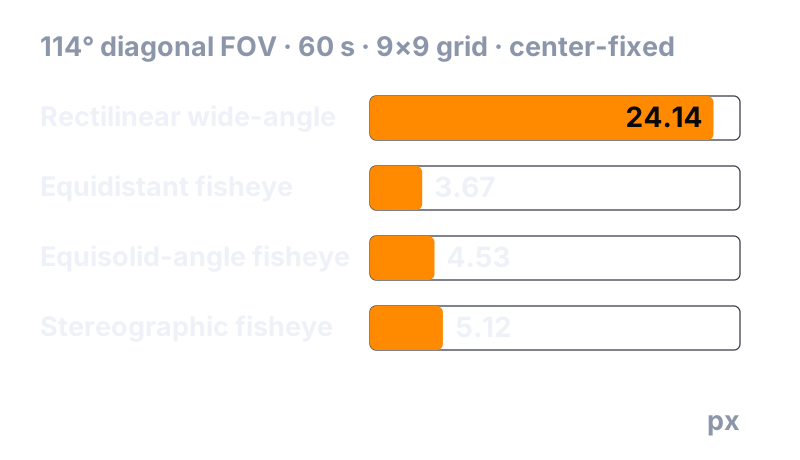
Fig. 5: Tracking residual compared at a diagonal field of view matched to 114 degrees. Matched to the stars at the center of the frame (center-fixed), 9×9 grid. An idealized model — not a measurement of an actual PENTAX body.
That is a considerable difference.
Comparing at the same focal length of 15 mm also gave a smaller residual for the fisheye than for the ordinary wide-angle lens in the model.
So my long-held understanding that
"the stars near the edges trail because it is a fisheye"
does not explain it.
If anything, in this model the result was that
if you are covering the same wide field of view, the fisheye projection is more favorable for Astrotracer
So from what focal length does the fisheye become better?
Seeing that result, the next thing I wanted to know was this.
"If the fisheye gets better the wider you go, isn't there a crossover somewhere?"
Something like
"beyond a diagonal field of view of N degrees the fisheye is better,"
or
"wider than N mm the fisheye is better."
So I ran an additional calculation.
With the diagonal field of view matched, I compared at 16 points from 5 to 165 degrees.
The result:
there was no place where it reversed.
At all 16 points tested, the fisheye's tracking residual was the smaller one.
For example, comparing the smallest-residual of the three fisheye projections against the ordinary wide-angle lens:
diagonal FOV 20°
rectilinear: about 2.81 px
fisheye: about 0.60 px
diagonal FOV 84°
rectilinear: about 14.11 px
fisheye: about 2.61 px
diagonal FOV 165°
rectilinear: about 121.43 px
fisheye: about 5.81 px
The wider you go, the larger the difference becomes.
Here, a ratio of 1.0 means the fisheye and the rectilinear lens have the same tracking residual; below 1.0 means the fisheye's residual is smaller.
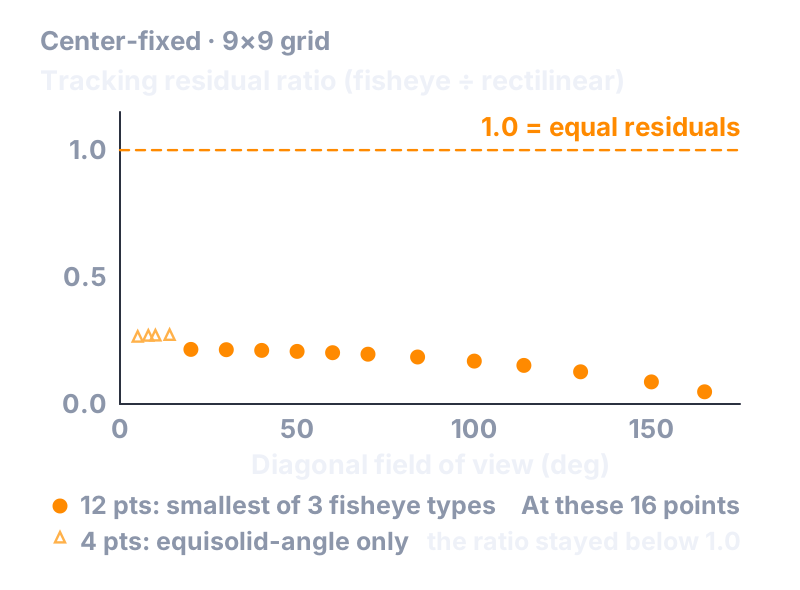
Fig. 6: Not a continuous sweep — a result evaluated at 16 points. ● is the smallest of the three fisheye projections; △ compares the equisolid-angle projection alone. A ratio of 1.0 means the fisheye and rectilinear residuals are equal; below 1.0 the fisheye is smaller. At these 16 points the ratio did not exceed 1.0 — that is the conclusion, and it is not a proof that this holds at every field of view. Center-fixed, 9×9 grid.
So I cannot write
"from N mm onward the fisheye is better."
What this idealized model supports is that
at the same field of view, across the range tested, the fisheye consistently had the smaller geometric tracking residual, and the difference grew as the field of view widened.
That was quite an unexpected result for me.
Why is the fisheye more favorable?
The fisheye looks far more distorted.
So why is its tracking residual smaller?
The word "distorted" is a little tricky here.
Ordinary ultra-wide lenses are designed to render straight lines as straight lines.
At first glance that seems more natural.
In exchange, however, they stretch the image strongly near the edges of the frame.
That is why faces and objects in the corners of an ultra-wide frame look pulled sideways.
A fisheye bends straight lines, but in exchange it stretches the periphery differently.
What is at issue here is not
whether straight lines come out straight.
It is how well a slight rotation of the celestial sphere can be approximated by shifting and rotating a plane at the sensor.
From that point of view, the fisheye projection was more convenient than the ordinary wide-angle projection.
At least in this idealized model, that is the result.
But "a fisheye means the stars don't trail" is not true
Please do not misread this.
The result here does not mean
a fisheye holds the stars perfectly all the way to the edges with Astrotracer
Fisheyes have residuals too.
And in real shooting, beyond the geometric residual, star images are affected by
tracking accuracy, calibration error, lens aberrations, distortion, focus, vibration, atmospheric effects and more.
What I compared here is an idealized model with all of that removed.
So it cannot be used as a performance evaluation of an actual body in the sense of
"this lens will actually trail N px."
What can be said here is that
"a fisheye projection is not necessarily worse for Astrotracer."
Comparing pure projection geometry alone, under these conditions, it was the other way around.
So why doesn't the same problem occur with an equatorial mount?
At this point the difference from an equatorial mount becomes important.
In Astrotracer ① "Why Do the Stars Stay Sharp While the Ground Blurs?" I wrote that
"with Astrotracer or with an equatorial mount, hold the stars and the ground blurs."
The basic phenomenon in real shooting is the same.
But the way the stars are held is different.
An equatorial mount rotates the camera and lens themselves in step with the Earth's rotation.
That is, it changes the camera's orientation before the light from the stars is projected into the photograph by the lens.
With Astrotracer, the camera and lens are fixed.
Light from the stars is first projected onto the image plane by the fixed lens.
Only then does the image sensor move to follow the star images.
In other words:
an equatorial mount follows the stars "before projection."
Astrotracer follows them "after projection."
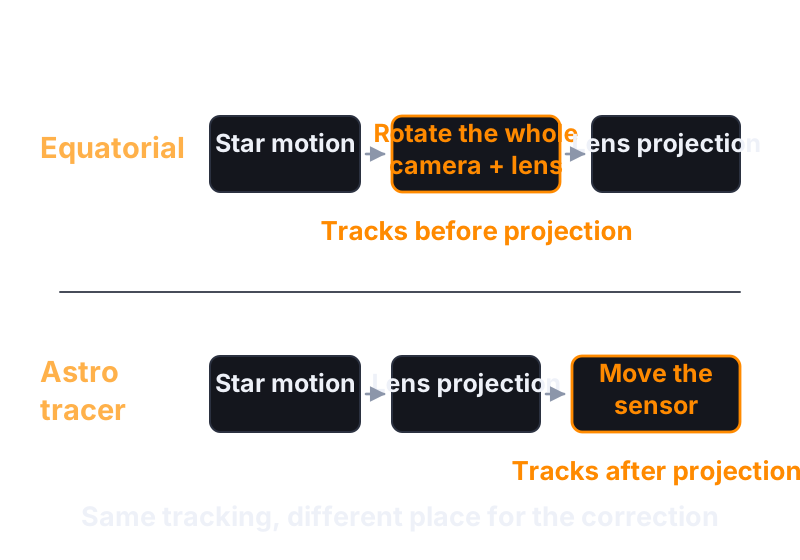
Fig. 7: An equatorial mount tracks before the projection; Astrotracer tracks after it. Both follow the stars, but they are not doing the same thing.
That becomes a major difference when thinking about star images near the edges.
An equatorial mount rotates the optics together with the sky
Consider an ideal equatorial mount.
Assume the polar axis is aligned perfectly, with no mechanical error and no atmospheric effects.
The mount rotates the whole camera and lens so as to cancel the Earth's rotation.
The camera's orientation as seen from the stars is then preserved.
Because the direction in which a star enters the lens does not change, its position after projection by the lens does not change either.
Whatever projection the lens uses, the direction going into that projection is being matched.
So in the ideal model the stars are held not only at the center of the frame but near the edges as well.
Astrotracer is different.
Because the lens is fixed, the direction in which a star enters the lens changes over time.
Each time, the lens projects the star to a different position.
The image formed after that projection is then followed by shifting and rotating a single image sensor.
But the change across the whole frame produced by the projection cannot necessarily be reproduced exactly by a planar X/Y shift plus rotation.
That difference remains as the tracking residual near the edges of the frame.
Calling it a "simplified equatorial mount" is not wrong
The manufacturer itself has described Astrotracer as a "simplified equatorial mount function."
As a way of explaining a function that
follows the motion of the stars caused by the Earth's rotation, so that they are recorded close to points even in a long exposure
I think that is very easy to understand.
I too thought of Astrotracer as something close to an equatorial mount in that sense.
Having calculated as far as the star images near the edges, though, it becomes clear that
even when both "follow the stars," they are not doing the same thing geometrically
An equatorial mount moves the optics themselves.
Astrotracer follows, with the image sensor, the image formed by fixed optics.
In everyday shooting you can use Astrotracer without being aware of this difference.
But go ultra-wide and start considering the edges of the frame rigorously, and the difference becomes visible.
What is interesting is that lens distortion also shows up in a different place
While working through this idealized model I found one more interesting difference.
Suppose the lens projection has distortion that departs from the ideal projection formula.
With Astrotracer the lens is fixed.
Stars are projected to different positions on the lens over time, and the image after that projection is followed by the sensor.
So the lens's non-linear distortion can appear as tracking residual on the star side.
With an ideal equatorial mount, by contrast, the whole camera and lens rotate together with the stars.
Because a star keeps landing on almost the same place on the lens, that effect is less likely to appear as tracking residual on the star side.
Now, however, the ground moves across the lens, so the lens's projection characteristics show up in how the ground image blurs.
It is quite a fine point, but the idealized model also reveals the difference that
with Astrotracer the lens's projection characteristics tend to appear on the star side, while with an equatorial mount they tend to appear on the ground side.
Why I did not write this much in the 2019 article
In "Getting Started with Star-Landscape Photography," which I wrote for Dejicame Watch in 2019, I also published a 15 mm example shot with Astrotracer.
As I recall, even then I could see, looking at the edges of the frame, that the stars were not perfectly held.
But in that article I did not go into the trailing of the stars near the edges.
It was an article about how to shoot star-landscape photographs with Astrotracer, not an analysis of the mechanism behind tracking error.
It is not that I did not know the stars were trailing.
I simply did not pursue the cause any further.
And about fisheyes I thought
"it's a fisheye, so I suppose it can't be helped."
This time I calculated, for the first time, what was inside that "can't be helped."
The result:
it was not disadvantageous because it was a fisheye.
If anything, at the same field of view, the fisheye was better in this model.
The phenomenon I was seeing in real frames and what I believed about its cause were not the same thing.
Nor is it true that ultra-wide always trails
Finally, one more caution.
Reading this far you might think
"with Astrotracer, going ultra-wide always makes the stars near the edges trail."
That is not accurate either.
The result changes with the shooting direction.
So which direction is the hardest, and which the easiest?
I calculated the maximum residual near the edges of the frame while varying the declination of the frame center (its angle from the celestial equator).
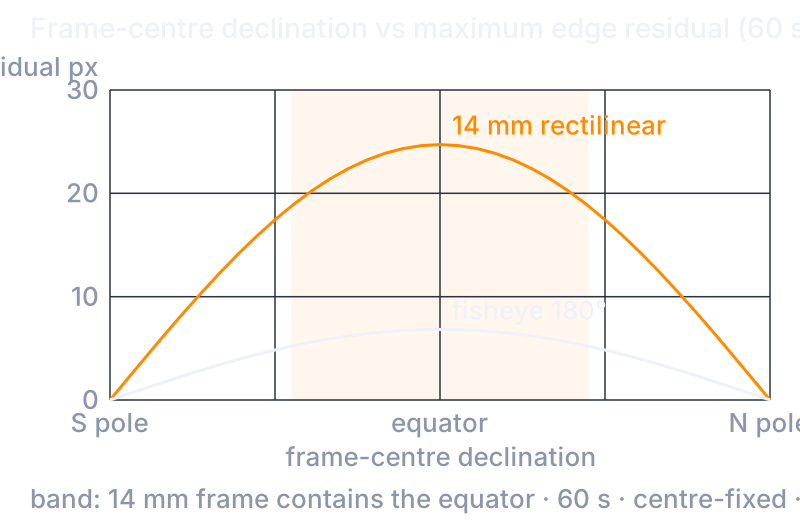
Fig. 8: Maximum residual near the edges of the frame as the declination of the frame center is varied (idealized model, 60 seconds, matched to the star at the frame center). A smooth curve that is largest when pointed at the celestial equator and zero at the celestial pole, with no step in the range where the equator falls inside the frame (the band). The 180° fisheye (equidistant projection) is consistently smaller than the ordinary 14 mm wide-angle lens. Not a measurement of an actual PENTAX camera.
Pointing at the celestial equator is the hardest case, and the residual falls smoothly as you point toward the celestial pole.
Here is something I had been wondering about myself.
In a composition that straddles the celestial equator, the stars turn the opposite way on the north and south sides of the equator. So does tracking "break down" at the equator?
When I calculated it, straddling the equator turned out to have no special significance in itself.
The curve in Fig. 8 continues smoothly through the range where the equator is inside the frame, with no step. The reason the residual is large in a composition that straddles the equator is not the straddling; it is that the frame center is close to the equator. In the northern sky or the southern sky, the result was the same at the same distance from the equator.
As Fig. 3 showed, what the north and south sides ask for is indeed opposite. But that difference does not appear suddenly at the equator; it changes smoothly across the frame. The X/Y shift and rotation given to a single image sensor are common to the whole frame. It cannot be given different motions for different places. That is why, at ultra-wide angles, the edges cannot be tracked completely.
And Fig. 8 shows one more thing. The 180° fisheye curve lies below the ordinary 14 mm wide-angle curve at every declination. "A fisheye is at a special disadvantage" is not something this model can say.
In an extreme case, under ideal conditions with the camera's optical axis pointed at the celestial pole, the rotation of the celestial sphere can be expressed as a rotation on the image plane.
That can be matched by rotating the image sensor.
In that case, in this ideal model, the tracking residual can be reduced to zero.
So the problem is not
"wide is always bad."
The field of view.
The shooting direction.
The camera orientation (even pointed the same way, the residual changes depending on whether the stars move along the long side of the frame or along the short side).
The lens projection.
The exposure time.
And how much residual you accept in a photograph.
It changes with all of those.
Here too it is the same as in Astrotracer ② "How Long Should You Track the Stars?".
How many pixels remain can be calculated.
But
how many pixels are still usable in a photograph is decided by the photographer.
Summary
Use an ultra-wide lens with Astrotracer and, even where the stars are held at the center of the frame, they can trail near the edges.
I have known about the phenomenon itself for a long time.
For fisheyes in particular I thought, for years, that
"it's a fisheye, so it can't be helped."
This time, though, idealizing the rotation of the celestial sphere, the lens projection and the image sensor's X/Y shift plus rotation, and calculating, showed a different picture.
With Astrotracer the order is
the motion of the stars on the celestial sphere
→ projected onto a plane by the lens
→ that image followed by shifting and rotating the image sensor
Because of that, the motion of the stars across the whole frame generally cannot be matched exactly by shifting and rotating a single image sensor.
The north and south sides of the frame ask for rotations in opposite directions, and near the equator that rotational component itself approaches zero. But zero rotation does not mean the whole frame can be tracked. Near the edges, the difference in how the projection onto a plane stretches the image remains. So nothing breaks suddenly at the equator itself, but the residual changes smoothly with declination, and in this model it was largest when pointed near the equator.
And the problem was not simply "because it is a fisheye" either.
In this idealized model, compared at the same diagonal field of view, the fisheye gave a smaller tracking residual than the ordinary wide-angle lens.
Even examining 16 points from a diagonal field of view of 5° to 165°, no crossover was found.
An equatorial mount, on the other hand, rotates the camera and lens themselves.
So in the ideal model the difference becomes
an equatorial mount tracks before the projection.
Astrotracer tracks after it.
Both follow the stars.
With both, holding the stars blurs the ground.
But they are not doing the same thing.
From the time I was using the first Astrotracer in 2011, I knew that the image sensor shifts and rotates to follow the stars.
What I learned this time was not that basic principle.
It was what geometric difference remains between the lens projection and the sensor's motion when you track a wide sky with that method.
And
whether my own explanation — "it's a fisheye, so it can't be helped" — was actually correct.
This is the result of going back and checking that.
I had used it for years and knew the phenomenon.
Even so:
that does not mean I correctly understood "why."
That was the most interesting part of this calculation for me.
→ Astrotracer ④ "How Did I Calculate Astrotracer Tracking Error?"