"About how many seconds should I track with Astrotracer?"
Once you actually start using it, I think this becomes a real question.
Thirty seconds?
One minute?
Two minutes?
Or should you use the full "tracking time" the camera displays?
In 2019 I introduced star-landscape photography with a PENTAX K-1 Mark II and Astrotracer in "Getting Started with Star-Landscape Photography" on Dejicame Watch.
In that article I explained that tracking is possible for up to five minutes depending on conditions, while also writing that in an actual star-landscape photograph I keep it to around one to two minutes, taking the blur of the landscape into account.
So:
if it can track for five minutes, why stop at one to two?
This is not simply a matter of
"Astrotracer gets less accurate at five minutes."
The reason is that
how many seconds the mechanism can track
and
how many seconds you want to track for the photograph
are two different questions in the first place.
In this article I want to break the "how many seconds?" of Astrotracer into parts.
The "tracking time" is not a guarantee that the stars stay points
This is quite important.
RICOH's published specifications for the O-GPS1 include a table of "Astrotracer tracking time" by focal length and declination.
For the K-3 Mark III, for example, at declination 0°:
200 mm: 80 s
100 mm: 160 s
50 mm and shorter: 300 s
At declination 90°, at the celestial pole, it is 300 s for every listed body and focal length.
Looking only at that, you might read it as
"the stars will stay points up to this time."
But the table is titled as a guideline.
RICOH's official FAQ is more explicit still.
It explains that the "tracking time" represents how long the image sensor can operate using the SR function, and that it is not a time that guarantees tracking performance.
In other words,
how many seconds the sensor can be moved
and
how long an exposure still records the stars cleanly as points
are not the same kind of time at all.
Type 3 makes this even clearer.
RICOH explains that with Type 3 you can set an exposure of up to ten minutes, while also saying that "keeping it within one minute lets you capture stars as points relatively reliably."
The time you can set.
The time the mechanism can move for.
The time over which stars are easy to record as points.
Even when they are all quoted as "a maximum of N minutes," these are different kinds of time.
"How many seconds?" contains several separate problems
So what actually determines the tracking time with Astrotracer?
Working through it this time, I found it easiest to think of five separate things.
T1 Mechanical tracking limit
First, the limit of the mechanism that moves the image sensor.
The sensor cannot be moved indefinitely.
The SR unit has a range of travel.
The "tracking time" the manufacturer quotes is basically this kind of time.
But as noted above, it does not mean "the stars stay perfectly still up to that time."
T2 Tracking accuracy limit
Even while the mechanism can still move the sensor, real tracking accumulates various errors.
How accurately were the azimuth and tilt obtained?
How accurate was the calibration?
If those errors add up, star trailing can become noticeable before the mechanical limit of travel is reached.
What that limit is in seconds on an actual PENTAX body is not something the material used here can tell us.
T3 Ground-blur limit
Even if the stars are tracked well enough, a star-landscape photograph also records the ground.
As explained in Astrotracer ① "Why Do the Stars Stay Sharp While the Ground Blurs?", tracking the stars blurs the ground.
So how much of that ground blur will you accept?
That is another condition that decides the tracking time.
T4 Star image limit near the frame edges
Go wider still — especially ultra-wide — and you cannot look only at the center of the frame.
Even where the stars are well held at the center, tracking residuals can appear near the edges.
In the idealized geometric model used here, there were conditions under which the star images near the edges of the frame became the binding constraint before the ground blur did.
Why that happens is covered in detail in Astrotracer ③ "Why Do Stars Still Trail Near the Edges with an Ultra-Wide Lens?".
T5 The exposure you actually use
And finally:
how many seconds will you actually shoot?
This is not determined automatically by any single one of T1–T4.
How far do you want to hold the stars?
How far do you want to hold the ground?
Will it end up on the web, or as a large print?
Will you examine the corners rigorously?
What are you prioritizing?
This is the time the photographer decides last, having considered all of that.
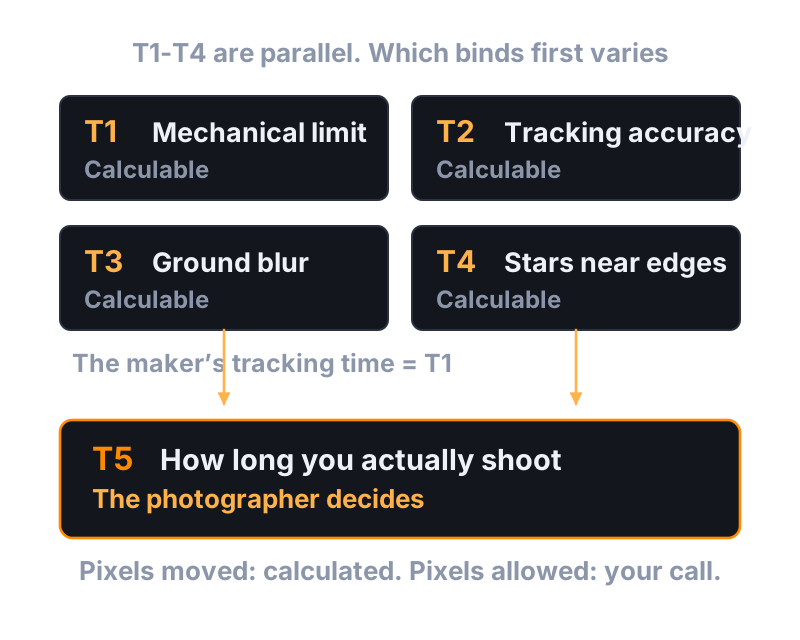
Fig. 1: T1–T4 are parallel constraints, not a sequence. Which one binds first changes with the shooting conditions. The "tracking time" a manufacturer quotes corresponds to T1, and is not a time that guarantees the stars stay points. T5 is decided last, by the photographer.
The thing to note here is that the limits do not arrive in the order
T1 → T2 → T3 → T4
T1–T4 are separate constraints.
Which one becomes a problem first depends on the shooting conditions.
What can be calculated and what the photographer decides are different
"So in the end you can't tell me how many seconds is correct."
You might feel that way.
But that is not quite it either.
There are parts that can be calculated physically.
For example:
if you track for 60 seconds, how many pixels does the image of the ground move?
Fix the conditions and that can be calculated.
Suppose the result is 3 pixels.
Then:
is a photograph a failure if it moved 3 pixels?
That is not decided by calculation alone.
A small web image and a large print are different.
Blur also looks different on a smooth mountain face than on a forest full of fine branches.
It differs again depending on whether you inspect the corners at 100% or view from a normal viewing distance.
The calculations here do use 3 px as a verification condition, but that does not mean
"up to 3 px is fine."
I think this point matters a great deal.
How many pixels something moves can be calculated by a computer.
But
how many pixels are acceptable is decided by the photographer.
Producing a physical quantity by calculation and judging it as a photograph are two different things.
The same 60 seconds is not the same at 14 mm and 50 mm
Let me look at ground blur a little more concretely.
I calculated this using an idealized sensor-shift tracking model.
The conditions are
full frame
latitude 35°
facing south
altitude 40°
60 s exposure
With Type 1-equivalent tracking, the blur of the ground image at the center of the frame came out as
14 mm: about 12.5 px
20 mm: about 17.6 px
24 mm: about 21.0 px
35 mm: about 30.5 px
50 mm: about 43.4 px
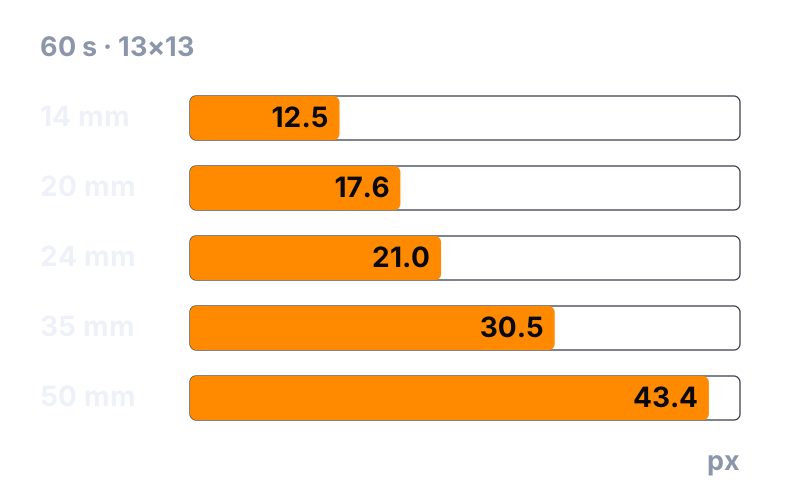
Fig. 2: Ground blur at the center of the frame, calculated with an idealized model. Full frame, latitude 35°, facing south at 40° altitude, 60 s, 13×13 grid. Not a measurement of an actual PENTAX body.
These are not measurements of an actual PENTAX body.
They are values calculated with an idealized sensor-shift tracking model.
Even so, it is clear that
"one minute is the same for any lens"
is not true.
Between 14 mm and 50 mm, the amount of ground blur recorded on the sensor in the same 60 seconds differs by a factor of about 3.5.
Of course, the sky is not rotating faster only at 50 mm.
The same angular motion is simply recorded larger by a longer focal length.
So is it "two minutes at 15 mm, one minute at 30 mm"?
Reading this far you might think
"if the focal length doubles, just halve the exposure?"
If you look only at ground blur at the center of the frame, that idea works with conditions attached.
The same shooting direction.
The same body.
The same acceptable blur.
And comparing at the center of the frame.
If all of those hold, doubling the focal length roughly halves the time to reach the same ground blur.
But you cannot turn that directly into
"the correct exposure time for Astrotracer."
Change the shooting direction and the motion changes.
Near the edges of the frame, the ground also blurs differently than at the center.
And with ultra-wide lenses, the star images near the edges can become a problem before the ground does.
Ground blur alone may follow a simple proportional relationship, but the usable exposure time for the whole photograph is not decided by that alone.
Calculating the "1–2 minutes" from 2019
So what about the "one to two minutes" I wrote in 2019?
That article showed an Astrotracer example shot at Mt. Tsubakuro with a PENTAX K-1 Mark II and a 15-30mm F2.8.
The example was
15 mm / f/2.8 / 60 s / ISO 3200
In the article I wrote that while tracking is possible for up to five minutes depending on conditions, in star-landscape photography the landscape blurs by however much you hold the stars, so I keep it to around one to two minutes.
It is not that in 2026 I realized for the first time that
"the maximum tracking time and the time you actually use are different."
I had already thought of the two separately.
When shooting example images for the manufacturer, showing how far the product can track has its own value.
So for images intended to demonstrate Astrotracer's capability, I did sometimes use the maximum tracking time.
When I shoot a star-landscape photograph for myself, however, tracking to the maximum is not the goal in itself.
I look at the stars and the ground and choose the time I want to use for the photograph.
At 15 mm, that was usually about one to two minutes.
So what does the current model give for that experience-based value?
As conditions close to the 2019 shoot, I calculated
15 mm
K-1 Mark II equivalent
near Mt. Tsubakuro, latitude 36.4°
a shooting direction assuming the galactic center as it was then
The ground blur came out as
60 s: about 12.1 px at the center of the frame / about 18.9 px maximum within the frame
120 s: about 24.2 px / about 37.7 px
300 s: about 60.4 px / about 94.4 px
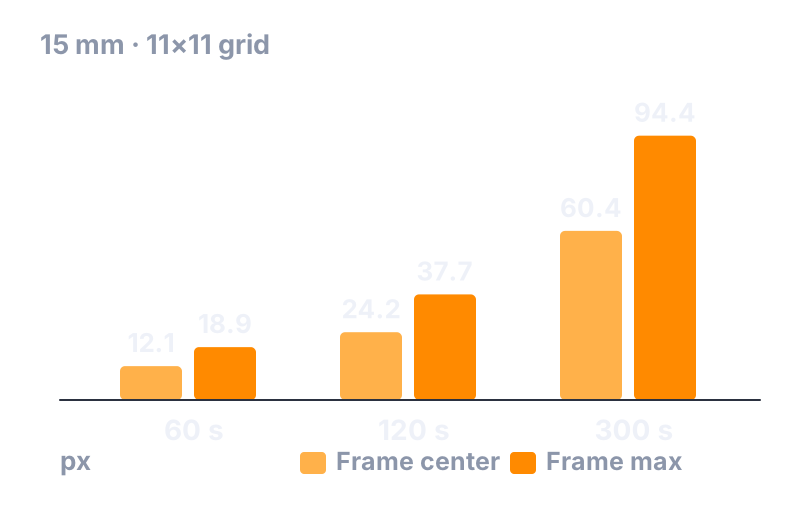
Fig. 3: Conditions close to the 2019 example, recalculated in 2026 with an idealized model. 15 mm, latitude 36.4°, facing south at 25° altitude, 11×11 grid. Not a measurement of the 2019 photograph.
To repeat: these are not numbers obtained by measuring the 2019 photograph.
They are values calculated with an idealized model in 2026.
Even so, the meaning of what I was doing empirically at the time becomes visible.
Even if it can track for up to five minutes, the ground blur keeps growing with time.
That is why I did not simply use the maximum tracking time, and used about one to two minutes at 15 mm.
That way of thinking is not contradicted by this calculation.
However,
the number "1–2 minutes" cannot be turned into a general rule.
That distinction has to be kept.
Because it was 15 mm.
Because it was that shooting direction.
Because, for that photograph, that was how much ground blur I accepted.
It is a practical value that came out of those conditions.
But even in 2019 I could see the stars trailing in the corners
Here I want to make an important correction in this article.
In the 2019 piece I used the blur of the landscape to explain tracking time.
That does not mean that at the time I
"was only looking at the ground."
Looking at the edges of the actual frames, I could see that the stars were not perfectly held.
What I did not do in the 2019 article was dig into why.
That article was about how to shoot star-landscape photographs with Astrotracer, not an analysis of the mechanism behind tracking error.
So:
it is not that I did not know the stars were trailing.
I simply did not pursue the cause any further.
This time, calculating conditions close to that 15 mm / 60 s case with the idealized model, the maximum ground blur is about 18.9 px while the tracking residual for the stars in the corners is about 20.5 px.
Of course, that 20.5 px cannot be applied directly to the 2019 photograph.
It does not reproduce the control algorithm of an actual PENTAX body.
Real star images also involve tracking accuracy, calibration, lens aberrations, focus, vibration and other factors.
What this shows is only that
with ultra-wide lenses, the star images near the edges of the frame — not just the ground — can be a factor that decides the usable exposure time.
Why that happens is covered in Astrotracer ③ "Why Do Stars Still Trail Near the Edges with an Ultra-Wide Lens?".
The 500 rule is interesting read backwards
There was one more interesting result in these calculations.
If you shoot star-landscapes, you have probably heard of the "500 rule."
Generally it uses
500 ÷ focal length
as a guideline for the exposure in seconds that keeps the stars close to points in a fixed exposure.
For example:
14 mm → about 35.7 s
20 mm → 25 s
24 mm → about 20.8 s
35 mm → about 14.3 s
50 mm → 10 s
Of course, the 500 rule itself is not an absolute standard.
The acceptable time changes with sensor resolution, final output, and how strictly you want the stars to be points.
What is interesting is what happens when you work backwards to the image displacement the 500 rule implicitly accepts.
Under the conditions used here, that is about 36.5 µm on the sensor.
So what if you now calculate, with Astrotracer, the time for the ground to move that same 36.5 µm?
Toward the celestial equator:
14 mm → 35.7 s
20 mm → 25 s
24 mm → 20.8 s
35 mm → 14.3 s
50 mm → 10 s
The same as the 500 rule.
This is not a coincidence.
It is exactly what I wrote about in Astrotracer ① "Why Do the Stars Stay Sharp While the Ground Blurs?".
The same relative motion between the stars and the ground, caused by the same rotation of the Earth,
is seen in a fixed exposure as motion on the star side.
With Astrotracer, by tracking the stars, it is seen as motion on the ground side.
Set the same acceptable displacement and you get the same formula.
So you can think of it as:
turn the 500 rule inside out and it also appears as a guideline for how far you let the ground blur with Astrotracer.
That does not mean "just use the 500 rule with Astrotracer," though.
The number 500 is itself a rule of thumb that already contains a judgement about what is acceptable in a photograph.
So in the end we come back to:
how many µm, how many px something moves can be calculated.
How many µm, how many px are acceptable is decided by the photographer.
Can you use twice the time with Type 2?
Type 2 is another thing worth asking about.
RICOH describes Type 2 as a mode that makes the image sensor follow at half the speed of Type 1, suppressing the blur of the landscape so that the stars and the scenery are captured in a balanced way.
So it is tempting to think
"at half the speed, surely you can expose for twice as long?"
If you look only at the ground, that is a fairly natural idea.
The comparison from here on is calculated facing south at 30° altitude. The earlier ground-blur figures by focal length were facing south at 40° altitude, so please do not line the numbers up and compare them directly.
In the idealized model used here,
Type 1 at 60 s
and
Type 2 at 120 s
gave matching amounts of ground blur.
That held at 14 mm and at 24 mm alike.
So, considering the ground alone, the relationship
Type 1 60 s ≒ Type 2 120 s
does hold.
Look at the stars, however, and the story changes.
In the idealized model at 14 mm:
Type 1 at 60 s gives a residual of about 0.3 px for the stars at the center of the frame.
Type 2 at 120 s gives about 11.1 px.
That is almost the same as the roughly 11.4 px with no tracking at 60 s.
In the corners, Type 2 at 120 s produced a larger residual than Type 1 at 60 s.
So the statement
"with Type 2 you can expose twice as long"
may hold for the ground alone, but it cannot be generalized to the whole photograph.
Type 2 is not a mode for holding the stars perfectly in the first place.
It is a mode that changes the balance of how much motion is left on the star side and how much on the ground side.
So how many seconds should Astrotracer be set to?
Let me return to the original question.
How many seconds should you track with Astrotracer?
Unfortunately there is no universal answer of the form
"N seconds at 14 mm"
or
"N minutes with Astrotracer."
But that does not mean nothing can be said.
What you need to think about can be laid out.
T1 How many seconds can the mechanism track?
T2 How accurately can the stars actually be followed?
T3 How much ground blur will you allow?
T4 How much will you accept in the star images near the edges?
And finally:
T5 For this photograph, what do you prioritize?
The "one to two minutes" I wrote in 2019 is not a universal correct answer for Astrotracer.
It is the time I was choosing from actual frames while shooting star-landscapes with a K-1 Mark II and 15 mm.
And now, in 2026, I can calculate
"why that is"
in more detail than before.
But being able to calculate does not mean the computer decides the "correct exposure time."
What a computer can calculate goes as far as
under these conditions, the stars move this much.
The ground moves this much.
Looking at that result and deciding
for this photograph, this much is acceptable
is the photographer's job.
I think these two are better kept separate.
Next: why the stars near the edges do not quite stop
There is one problem I have not explained yet.
Astrotracer is tracking the stars, so why do the stars near the edges of the frame fail to stop once you go ultra-wide?
I had been seeing the phenomenon itself for a long time.
And for fisheye lenses I assumed, for years, that
"it's a fisheye, so it can't be helped."
This time, though, I calculated it while asking
"is it really because it is a fisheye?"
— and the result was the opposite of what I expected.
At the same field of view, in the idealized model, the fisheye actually gave a smaller tracking residual than the ordinary ultra-wide lens.
So what is the real cause?
It turned out to involve the difference in how Astrotracer and an equatorial mount follow the stars.
→ Astrotracer ③ "Why Do Stars Still Trail Near the Edges with an Ultra-Wide Lens?"