The star is just as bright either way. So why don't the trails look the same?
There are two main ways to photograph star trails.
One is a long exposure: leave the shutter open for 30 minutes.
The other is to shoot sixty consecutive 30-second frames and combine them afterwards with Lighten compositing — a common method of star-trail stacking.
In both cases, the star keeps sending light toward the camera throughout the 30 minutes. And the star itself, of course, is no brighter in one case than in the other.
So shouldn't the two come out looking the same?
I think that is a very natural question. And half of it is right. In this article I want to show where that half ends, and what happens in the other half — going all the way down to the individual pixels of the sensor.
Let me state the conclusion first.
The star did not become brighter or dimmer. What differs is how the light that arrived over those 30 minutes is turned into a single image.
"The star is just as bright, so why wouldn't it look the same?"
Let me look at the question a little more carefully.
The star shines for the whole 30 minutes. The camera receives its light for the whole 30 minutes. Whether that is one 30-minute frame or sixty 30-second frames, the total amount of light received should be the same.
So far, this is correct.
The problem is where on the sensor that light lands.
"The star shines for 30 minutes" and "one particular pixel on the sensor receives the star's light for 30 minutes" are two different statements.
The star does not sit still on the sensor
With a fixed camera, the Earth's rotation makes the star's image drift slowly across the sensor. That is why a trail is recorded in the first place.
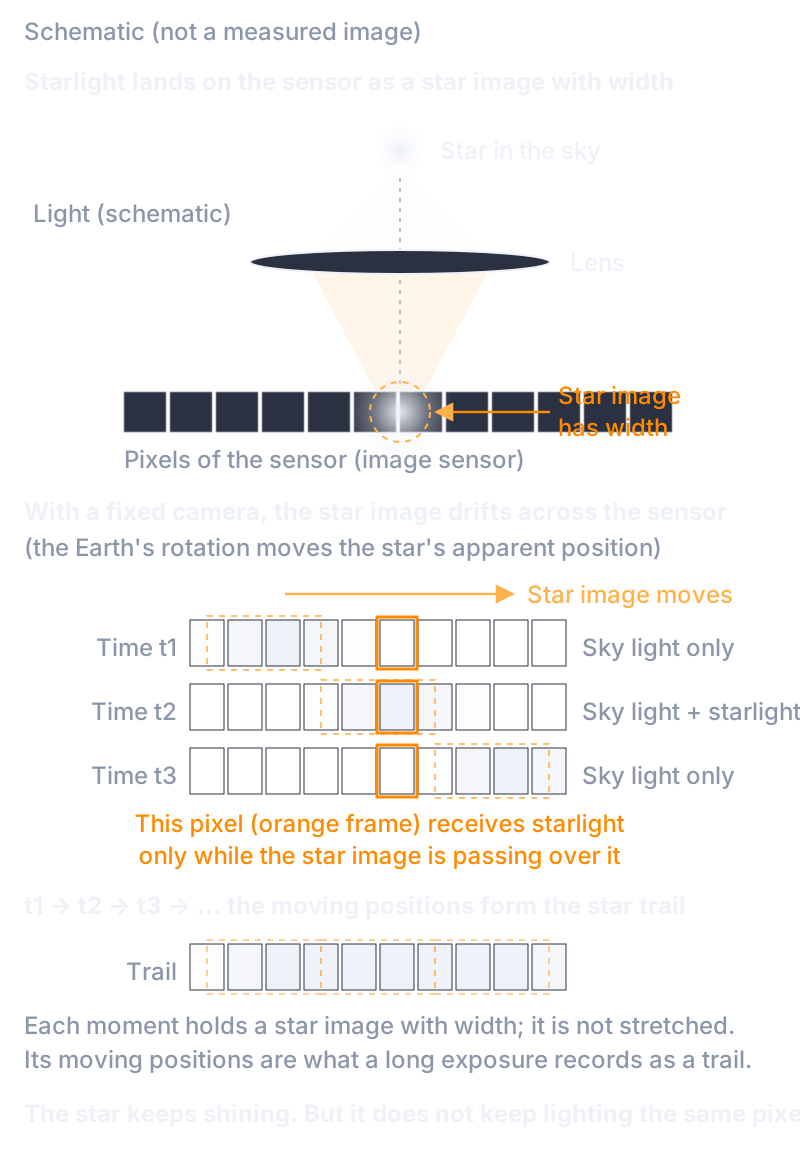
Figure 1: Light from a star passes through the lens and lands on the sensor as a star image of finite width; with a fixed camera that image drifts across the sensor over time (schematic). A given pixel receives the star's light only while the star image is passing over it. The light path, the shape and size of the star image and the amount of movement are schematic and are not measured values. Measured values appear in the next figure and in the text.
That means any pixel along the trail receives starlight only while the star image is passing over it. Once the image has moved on, the pixel receives nothing but sky light.
How long does that passage take?
I can calculate it from the 17-year-old Nikon D3 data I used in my previous article. In that data — 14 mm, 8-second exposures, shot continuously — the star image was about 4.52 pixels wide (full width at half maximum), and the star moved about 1.13 pixels per 8-second frame.
Divide one by the other and you get roughly 32 seconds for the star image to cross a single pixel. The speed depends on where the star is in the frame, so the range is roughly 20 to 60 seconds.
Thirty minutes is 1,800 seconds.
In other words, even in a "30-minute exposure", a given pixel on the trail receives the star's light for only about 30 seconds of that time. For the remaining twenty-nine and a half minutes, all that enters that pixel is sky light.
A 30-minute exposure does not mean that any one point on the trail was exposed for 30 minutes. This is the single most important point in the article.
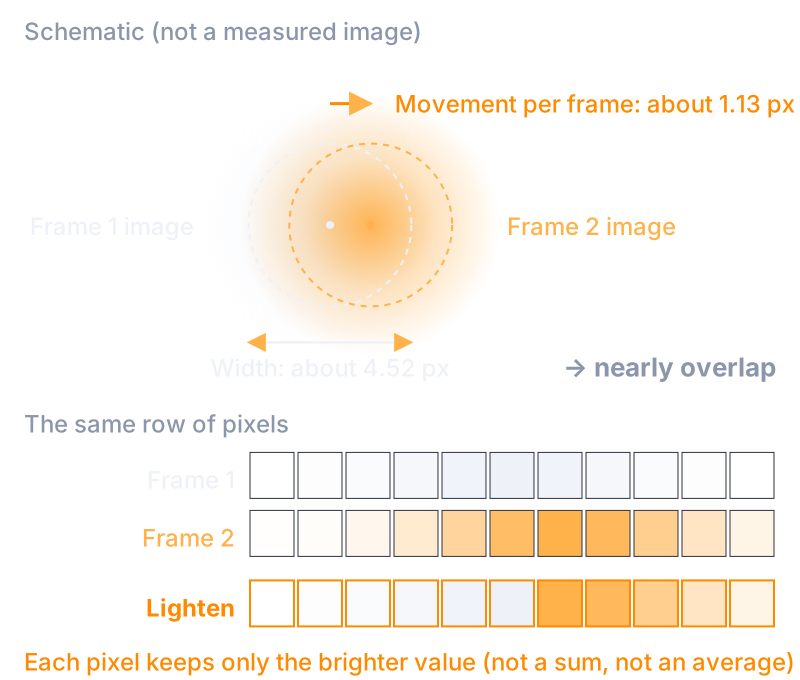
Figure 2: A star image has width, and it moves a little at a time across the sensor (schematic; reproduced from the previous article). The star-image width (about 4.52 pixels) and the movement per frame (about 1.13 pixels) are values from the D3 data, but the shape of the star image is simplified for explanation and is not a measured image. The lower half, showing how Lighten works, will be used later in this article.
What happens to a single pixel during a 30-minute exposure
From here on, let me focus on one pixel on the trail and watch it for 30 minutes.
To make the counting easier, I will divide the 30 minutes into sixty 30-second slots. A real long exposure has no frame boundaries, of course; the slots are just a way to count how the light comes in.
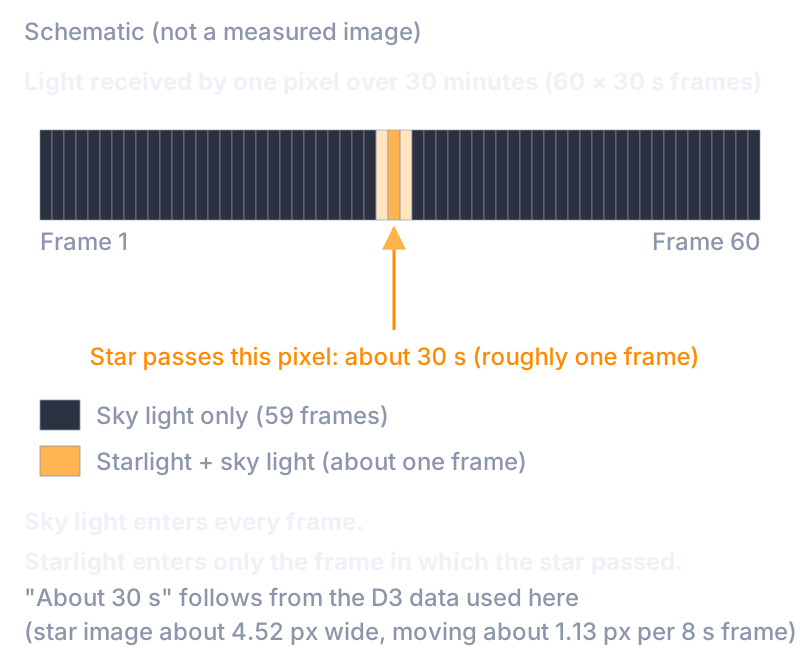
Figure 3: The light received by one pixel over 30 minutes (schematic). Sky light enters all 60 slots. Starlight enters only during the roughly 30 seconds — about one slot — in which the star image passes over that pixel. The "about 30 seconds" is calculated from the conditions of the D3 data used here and changes with the lens and the star's position.
The light this pixel collects over the 30 minutes breaks down like this:
- Sky light: all 60 slots' worth
- Starlight: only the one slot or so during which the star passed
In a long exposure, these two are added together into a single image.
The starlight does not increase if you expose for longer. Once the star has passed, no more of it arrives. A longer exposure makes the trail longer, not brighter.
Sky light, on the other hand, keeps accumulating in proportion to the exposure time. Light from towns, twilight and the atmosphere itself keeps arriving at that pixel the whole time.
So in a 30-minute exposure, the star trail is not getting dimmer — it is being buried under a sky that keeps getting brighter. That is what people mean when they say that star trails "fade" in a long exposure. What fades is not the trail itself but the difference in brightness between the trail and the sky.
What if you average 60 frames of 30 s?
Now let me return to the question we started with.
The intuition that "if the star is just as bright, it should look the same" is actually not far off.
Light adds up. So, in idealized terms, if you split the 30-minute exposure into sixty 30-second frames and then add those 60 frames together, you get the same distribution of light as the single 30-minute exposure. You only divided up the time; the light that arrived is the same.
"Averaging" is that sum divided by 60. Because it is only a division, the ratio between star and sky brightness is the same as in the sum.
So an average of sixty 30-second frames comes out looking very much like the single 30-minute exposure. The starlight is divided by 60 and becomes faint; the sky light is also divided by 60 and drops back to one frame's worth. The degree to which the star is buried in the sky is, ideally, the same as in the long exposure.
When I check this with an idealized model, the sum of the 60 frames matches the trail of one continuous exposure exactly, provided there are no gaps between frames, and the average is exactly one sixtieth of it.
But there is one thing I should be honest about here.
"One 30-minute frame equals the average of sixty 30-second frames" is an idealization. A real camera has many factors that depart from the ideal: per-frame read noise, dark current, sensor temperature, saturation of bright stars, RAW quantization, development processing, long-exposure noise reduction, the gaps between frames, and so on. Read noise in particular is added with every readout, so sixty readouts add sixty portions of it. The two will not necessarily be identical images.
Even so, this much holds: if you look at an averaged composite, you can see with your own eyes why star trails fade in a long exposure. Starlight is present in only a few of the frames, while sky light is present in all of them. The average simply puts that fact into one image.
What if you Lighten-composite the same 60 frames?
Lighten compositing is not averaging.
The Lighten blend mode in Photoshop keeps, for each pixel of the stacked images, the brightest value. It is neither addition nor division. It is a selection.
Think again about our single pixel. Its 60 values run like this:
background, background, background … star passing … background, background …
In an average, the 59 frames in which the star was absent also enter the calculation. That is why the starlight is diluted.
In Lighten, only the brightest of those 60 values survives — the value from the frame in which the star passed. The 59 star-less frames are, for that pixel, discarded.
What about the sky light? In a pixel the star never crosses, all 60 values are roughly the same sky value, so picking the brightest leaves the sky at one frame's worth. (Strictly speaking it picks the bright side of the noise and lifts the sky slightly; I will come back to that.)
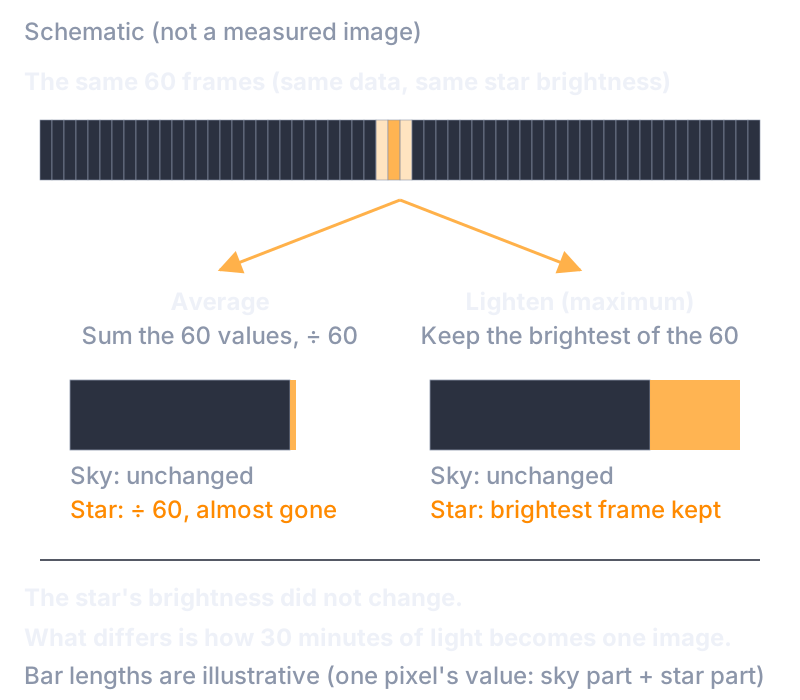
Figure 4: The same 60 frames, averaged or Lighten-composited (schematic). The captured data and the star's brightness are identical; only the final operation differs. Averaging divides the starlight by 60; Lighten keeps the value of the frame in which the star passed. The sky is unchanged in both. In reality the star image has width, and a star's contribution to one pixel can straddle several frames; to keep the principle clear, it is drawn here as passing in a single frame. Bar lengths are illustrative values.
What differs is not the star but the operation
Let me put everything on one page.
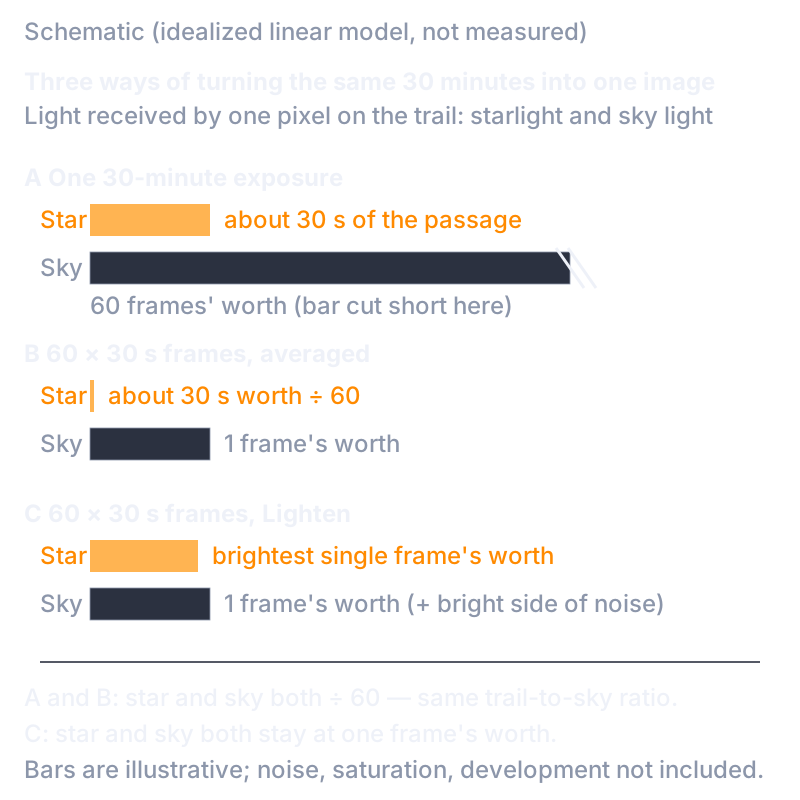
Figure 5: Three ways of turning the same 30 minutes into one image (schematic, idealized linear model). In A (long exposure) and B (average) the star and sky are in the same ratio, so they look the same. In C (Lighten) the star and sky both keep their one-frame relationship. Real-camera factors such as noise, saturation and development are not included.
| Starlight (one pixel on the trail) | Sky light | Nature of the operation | |
|---|---|---|---|
| A: one 30-minute exposure | The roughly 30 s of the star's passage | 30 minutes' worth | Recorded as a single exposure |
| B: 60 × 30 s frames, averaged | Roughly 30 s worth ÷ 60 | 30 seconds' worth | Time-divided exposures combined linearly |
| C: 60 × 30 s frames, Lighten | The brightest single frame's worth | 30 seconds' worth (plus the bright side of the noise) | The brighter value selected from each moment |
Table 1: How the three methods differ (idealized model). In C, the "starlight" is less than one frame's worth if the star's passage straddles two frames.
Laid out like this, it becomes clear.
In an idealized linear model, A and B represent the same distribution of light; B is A divided by 60. Both combine the light by adding star and sky together — with the caveat, as noted in the previous section, that they will not match exactly on a real camera.
Only C is a different kind of operation. Out of the 60 frames it selects, pixel by pixel, the brighter value. So the sky does not accumulate, and the star keeps the value of the frame in which it passed.
"A 30-minute long exposure" and "a Lighten composite of short exposures taken over 30 minutes" share the same total shooting time, but they are not the same image-forming process. It is not the star's brightness that differs, but the way information along the time axis is combined.
One clarification, to avoid a misunderstanding.
Lighten compositing does not make the stars brighter. What it preserves, along the trail, is the relationship between star and sky brightness from the short exposure in which the star was there.
So it is also not the case that Lighten makes the trail itself brighter than a long exposure would. In an idealized model, the brightness of a Lighten-composited trail is equal to that of one continuous exposure, or lower where the star images of successive frames overlap. What Lighten protects is not the brightness of the trail but the ratio of trail brightness to sky brightness. Because the sky stays at one frame's worth, the trail is not buried. That is all there is to it.
Why Lighten compositing is used for star trails
Once you understand the principle, the advantages usually attributed to Lighten compositing separate into two kinds.
One kind belongs to the Lighten operation itself. The other belongs to the shooting method of taking many short exposures in succession — and that second kind you would get with averaging as well.
Advantages of the Lighten operation itself
- Sky light does not accumulate with shooting time, so the trail is not buried in the sky the way it is in a long exposure or an average.
- Even under light pollution, the sky stays at one frame's brightness, so you can devote to the trail a total shooting time that a single long exposure could never sustain.
Advantages of shooting many short frames (obtainable without Lighten)
- Frames spoiled part-way through — car headlights, someone walking through, wind shake — can be left out individually.
- The length of the trail can be adjusted afterwards by choosing how many frames to use.
- You are not betting everything on one very long exposure. If clouds roll in half-way, the frames up to that point survive.
- Because each frame is short, problems specific to long exposures — the wait for long-exposure noise reduction, thermal noise that grows with exposure time — are confined to one frame at a time.
- The same sequence can be reused for a time-lapse or a single-frame nightscape. That versatility was one of the reasons I kept using an 8-second exposure for so long.
In other words, much of what gets called "the advantages of Lighten compositing" is really the advantage of shooting in short pieces. What Lighten itself contributes is one thing only: it joins the trail without piling up the sky.
The disadvantages of Lighten compositing
This is not going to be a one-sided story. A selection operation has weaknesses that come with being a selection.
It keeps every bright unwanted object. Lighten keeps the brightest value at each pixel. So if an aircraft, a satellite, a car's headlights or a torch beam appears in even one of the 60 frames, it will be in the final image, guaranteed. What averaging would dilute to one sixtieth, Lighten keeps at full strength. This is why removing aircraft trails is a permanent companion to Lighten compositing.
It picks only the bright side of the sky noise. Even in a pixel with no star, the 60 values differ slightly because of noise. Lighten picks the brightest of them, so the sky is left slightly lifted toward the bright side compared with a single frame. Defects that are bright in the same place in every frame, such as hot pixels, also survive unchanged. Averaging does the opposite: noise is smoothed out and reduced. An idealized model confirms the direction: Lighten raises the mean level of the sky, while averaging reduces its scatter.
It is vulnerable to changes in the sky and clouds. If a cloud passes or the town lights change during the 60 frames, the sky of the frame that got brighter is selected as that pixel's "brightest value". Changes that a long exposure would smooth out are kept on the bright side by Lighten.
Frame boundaries and uneven brightness can become visible. In an idealized model, Lighten can produce a dip in brightness at the boundary between adjacent frames. And a selection operation can carry any frame-to-frame variation in brightness that existed before compositing straight into the trail as light and dark patches. I take this up in the next section, in connection with my previous article.
A true gap cannot be filled by any operation. If the interval between frames is so long that the star moves further than the width of its own image, the light from that interval is recorded in no frame at all. Light that was never recorded cannot be manufactured by Lighten, nor by averaging. With long-exposure noise reduction switched on, for example, the manual of the D3 I was using states that processing lasting roughly as long as the exposure follows each shot and that no photographs can be taken in the meantime. For the continuous sequences I shot on the D3 for Lighten compositing, I kept long-exposure noise reduction switched off.
It takes many frames and some processing. Sixty frames for 30 minutes; several thousand for a night. Neither the storage nor the compositing effort bears comparison with a single long exposure.
It is a different image from a long exposure. Lighten compositing is not a substitute for a long exposure. The treatment of the sky, the character of the noise and the appearance of frame boundaries are all different. It is a different image-forming process.
Why the D3 trails looked "wavy"
Since the D3 era I have made star trails by Lighten-compositing continuous sequences of 8-second frames. When I viewed those trails at 100%, the lines looked broken in places. At the time I put this down to the tiny gap between shutter closings — a "true gap", in the terms of this article.
When I re-examined the original NEF files 17 years later, the gaps alone could not explain it. In the roughly 0.1 seconds between frames the star moves about 0.012 pixels — negligible against the width of the star image. Yet the unevenness was real, and the measured brightness of the star was already fluctuating from frame to frame before compositing. Lighten compositing was the main stage that selected and amplified that fluctuation. The very character of the selection operation described in this article was involved in those patches. What physically causes the fluctuation, and what sets the period of the patches, is still unknown.
The details are in Why do star trails show seams even though the frames were shot continuously?.
Summary
The star's brightness is the same. The time during which its light kept reaching the camera is the same.
What differs is how the light that reached the sensor over those 30 minutes is combined into one image.
- A long exposure records the light of the 30 minutes as a single exposure. Starlight arrives for only the few tens of seconds of the star's passage, while sky light accumulates for the full 30 minutes.
- Averaging (or summing) short exposures combines the time-divided exposures linearly. Ideally this looks the same as the long exposure; on a real camera it departs from it by the read noise and other factors.
- Lighten compositing selects, pixel by pixel, the brighter value from each moment and builds the trail from those. The sky stays at one frame's worth and the trail is not buried — but bright unwanted objects and the bright side of the noise are kept as well.
This is not a question of which method is better. They combine information along the time axis differently and produce different images. Knowing that, you choose according to what you want to photograph.
The figure of "about 30 seconds of starlight per pixel" in this article was calculated from real data under one set of conditions: a D3, a 14 mm lens and 8-second exposures. It changes with the focal length and with where the star is in the frame. But the underlying picture — that a 30-minute exposure does not expose any one pixel for 30 minutes — is the same under any conditions.